America Wants Manufacturing Jobs Back. The New Factories May Not Bring the Old Jobs With Them.
For decades, manufacturing jobs represented one of the clearest paths into the American middle class. A worker without a four-year degree could enter a factory, earn a solid wage, receive benefits and often build a stable life around a single employer. That model weakened dramatically as automation, globalization and changing consumer demand reshaped the economy.
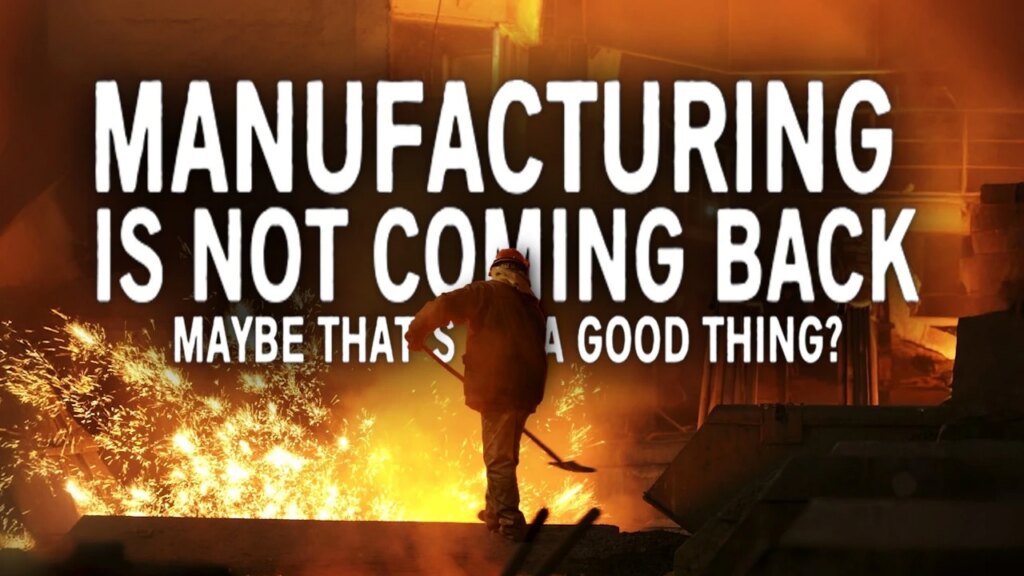
Now manufacturing is fashionable again. Governments are offering incentives, companies are building plants and policymakers across the political spectrum talk about reshoring critical industries. Yet the factories coming back are not necessarily recreating the employment structure that disappeared.
Manufacturing Employment Really Did Collapse
U.S. manufacturing employment peaked at about 19.6 million jobs in June 1979. By June 2019, that number had fallen to about 12.8 million, a decline of roughly 35%. Over the same period, total nonfarm employment rose from about 90 million to more than 150 million, meaning manufacturing became a dramatically smaller share of the American labor market.
At its peak, manufacturing accounted for about 22% of total nonfarm employment. By 2019, the share had fallen to roughly 9%. The jobs did not disappear because Americans stopped consuming manufactured goods; they disappeared because factories became more productive, companies moved production abroad and the economy shifted increasingly toward services.
That long decline changed the social meaning of factory work. Manufacturing went from being one of the dominant forms of middle-class employment to a much smaller part of a far larger economy. The jobs that remain can still pay well, but they no longer define the labor market the way they once did.
Automation Was Just as Important as Offshoring
Globalization usually gets most of the blame for manufacturing job losses, and offshoring clearly played a major role. Lower labor costs abroad encouraged companies to move production to China, Mexico and other emerging markets, while imported goods became more competitive with American-made products. BLS has cited trade liberalization alongside technological change and productivity gains as key drivers of the long-term decline.
But automation also transformed what a factory needed from its workforce. Machines became more productive, computerized systems replaced repetitive tasks and factories learned to produce more output with fewer employees. Manufacturing could therefore remain economically important even while its employment footprint shrank.
That distinction matters today. Bringing production back to the United States does not automatically recreate the labor intensity of a 1970s factory. A modern plant may produce vastly more output with far fewer workers.
The New Factory Is Often a Technology Company in Disguise
Modern manufacturing increasingly depends on robotics, software, advanced machinery and highly specialized technicians. The old image of hundreds of workers performing repetitive manual tasks is giving way to facilities where smaller teams monitor automated systems, maintain equipment and manage complex production processes.
The extreme version is the so-called dark factory, a highly automated plant that can operate with minimal human presence. Fully human-free facilities remain rare, but the direction of travel is clear: companies want more output per worker and fewer points of production failure. Automation becomes particularly attractive when skilled labor is scarce or wages are rising.
That means reshoring can increase domestic production without producing a proportional increase in employment. The United States can manufacture more goods at home while still employing far fewer factory workers than it did in the past.
Manufacturing Is Starting to Grow Again
The story is not entirely one of decline. Manufacturing employment had risen by 72,000 jobs from a recent low in December 2025 through September 2026, according to BLS. September itself added about 9,000 manufacturing jobs, with gains in machinery and plastics and rubber products.
Foreign direct investment is also flowing heavily into American manufacturing. In 2025, manufacturing accounted for about $121.8 billion, or 52.5%, of all expenditures for new foreign direct investment in the United States. Chemicals, plastics and other industrial categories attracted particularly large commitments.
Those numbers show that reshoring and industrial investment are real. What they do not prove is that manufacturing employment will return to its old peak. BLS projects total manufacturing employment to remain roughly flat from 2024 through 2034, even while specific industries and occupations grow.
The Opportunity Is in Replacement Jobs and Skilled Roles
BLS projects nearly 1 million openings per year in production occupations from 2024 through 2034. Most of those openings are expected to come from workers retiring, changing occupations or otherwise leaving the field rather than from large net employment growth.
That means there can be substantial hiring even when total factory employment barely changes. An aging workforce creates vacancies, while new plants need machinists, technicians, engineers and maintenance workers. The shortage is increasingly about the right skills rather than the absolute number of available workers.
For someone entering the labor market today, that can still represent a real opportunity. Manufacturing may not recreate tens of millions of jobs, but selected skilled roles can offer strong wages without requiring a traditional four-year college degree.
Factory Work Is Becoming Attractive Again for a Reason
The perception of manufacturing is changing partly because the alternative has changed. Office work was once seen as the obvious upgrade from factory work, especially for younger Americans encouraged to pursue college degrees. Today, many white-collar workers face expensive housing, student debt, uncertain career paths and growing anxiety about automation in administrative and professional jobs.
Manufacturing can look more appealing by comparison. Skilled trades and industrial jobs can provide tangible work, relatively strong wages and clear technical career paths. In some regions, the cost of living around manufacturing centers is also lower than in major cities dominated by finance and technology.
The irony is that factory work became more desirable at the same time factories became harder to staff. Companies increasingly need workers with technical skills, while decades of cultural messaging told younger people that success meant avoiding manufacturing altogether.
Unionized Manufacturing Still Shows the Value of Benefits
One reason manufacturing jobs once supported families so effectively was compensation beyond the hourly wage. Union contracts often included pensions, health insurance, paid leave and other benefits that made total compensation substantially higher than the paycheck alone suggested.
That pattern still exists. In June 2026, private-sector union workers averaged $63.06 per hour in total employer compensation, compared with lower total compensation for nonunion workers. Union employees received especially large advantages in retirement, insurance and paid-leave benefits.
Manufacturing specifically continues to provide meaningful benefit packages. BLS reported average total compensation of $59.23 per hour for manufacturing workers in June 2026, with more than $25 per hour coming from benefits. That helps explain why a stable industrial job can still be financially attractive even when the work itself is demanding.
The Old Middle-Class Factory Model Is Hard to Rebuild
The problem is that the old manufacturing system depended on more than factories. It depended on scale, unions, domestic supply chains and relatively limited global competition. A company could employ thousands of workers in one facility because production technology required them.
Modern companies face different incentives. If a new factory can produce the same output with 500 workers instead of 5,000, investors generally prefer the more automated version. Reshoring can therefore bring production capacity back without bringing back the same number of jobs.
This is one reason nostalgia can distort manufacturing policy. The goal of rebuilding domestic production is economically different from recreating the employment structure of 1979. The first may be achievable; the second is much harder.
Tariffs Can Encourage Production but Also Raise Costs
Tariffs are often used as a tool to make imported goods more expensive and encourage domestic production. In theory, that can make U.S. factories more competitive by narrowing the cost difference between domestic and foreign manufacturing. Governments can pair tariffs with subsidies, tax credits and procurement rules to strengthen the effect.
The trade-off is that tariffs also raise input costs for companies that rely on imported components. A manufacturer protected from foreign competition in one part of its business may pay more for steel, electronics or machinery imported from somewhere else. Those higher costs can reduce the incentive to hire or invest.
Recent experience shows why the outcome is complicated. Tariffs and industrial policy have encouraged some new manufacturing investment, but factory employment still fell sharply through parts of 2025 before recovering somewhat in 2026. Industrial policy can influence where companies invest, but it cannot eliminate the economics of automation and global supply chains.
Foreign Investment Is Becoming Part of the Reshoring Story
Some of the biggest new American manufacturing investments are coming from foreign companies rather than domestic firms. Japanese, German, Canadian and South Korean companies have been among the largest investors in new U.S. operations.
That can still benefit American workers. A foreign-owned factory located in Pennsylvania, Texas or Georgia creates domestic employment and purchases from local suppliers regardless of where the parent company is headquartered. The more important question is how much of the supply chain develops around the plant.
U.S. officials have increasingly focused on exactly that problem. Foreign investors building factories in America have reported difficulty finding domestic suppliers for specialized components and equipment, which has led policymakers to push programs aimed at rebuilding the surrounding supplier base.
Supply Chains Matter More Than a Single Factory
Manufacturing strength is not just about constructing a large plant. Modern industrial production depends on thousands of specialized suppliers, logistics networks, skilled workers and reliable energy. A country can build an assembly facility quickly while still relying heavily on imported components.
That is one reason China remains so difficult to replace. Companies that moved production to Southeast Asia have sometimes discovered that China still offers deeper supplier networks, more specialized equipment and more reliable infrastructure. Some firms have even shifted portions of production back after attempts to diversify away proved more expensive or complicated than expected.
The lesson for the United States is that manufacturing policy must extend beyond headline factory announcements. A durable industrial base requires an ecosystem of smaller suppliers and technical expertise that can take years to rebuild.
The Skilled-Labor Shortage Is Real
Manufacturers frequently report difficulty finding workers with the exact technical skills required for modern production. Machinists, welders, maintenance technicians, industrial electricians and other specialized roles require training that cannot be created overnight. That shortage can delay production even when companies are willing to invest.
The mismatch is partly the result of decades of educational and cultural priorities. Young people were often encouraged toward four-year degrees while vocational and technical pathways received less attention. At the same time, many experienced factory workers aged toward retirement.
This is why rebuilding manufacturing requires workforce policy as much as trade policy. Apprenticeships, community colleges and employer training programs may matter just as much as tariffs or tax credits. A factory without enough trained workers cannot operate efficiently regardless of where it is built.
White-Collar Work Is Facing Its Own Automation Problem
Manufacturing workers have lived with automation for decades. Office workers increasingly face the same issue. Artificial intelligence and software automation are beginning to affect administrative, analytical and professional tasks that once seemed relatively insulated from technological displacement.
That makes the manufacturing debate more complicated. The economy cannot simply assume workers displaced from factories will move permanently into safer service jobs. Some of those service jobs are now being redesigned by AI in the same way machines redesigned production work.
The next labor-market divide may therefore be less about blue collar versus white collar and more about who can work alongside technology. Workers who can operate, repair, design or manage automated systems may be better positioned than those whose tasks can be easily standardized.
Services Are Not Automatically Low-Value Work
It is tempting to argue that the shift from manufacturing to services created unnecessary or less productive jobs. That is too broad. Healthcare, software, finance, logistics and professional services can produce enormous economic value even though they do not manufacture physical products.
The real problem is that many service jobs do not provide the same combination of wages, benefits and job security that unionized manufacturing once offered. The economy created enormous numbers of service-sector jobs, but the quality of those jobs varies widely. A highly paid software engineer and a low-wage retail worker are both counted as service workers despite having little in common economically.
That distinction helps explain the nostalgia for factory employment. People are not necessarily longing for assembly-line work itself. They are often longing for jobs that allow someone without an advanced degree to support a family and build long-term financial security.
Manufacturing Can Return Without Becoming the Largest Employer Again
The United States can rebuild strategic manufacturing without reversing the entire transition toward services. Semiconductor plants, battery factories, pharmaceutical production, defense manufacturing and advanced machinery can all expand while manufacturing remains a relatively small share of overall employment.
That may actually be the more realistic objective. Domestic production in critical industries can improve supply-chain resilience and national security even if those facilities employ fewer people than factories of the past. The value of manufacturing should therefore not be measured only by headcount.
A highly automated semiconductor plant employing 2,000 skilled workers can have enormous economic importance. It can also support suppliers, construction jobs and related services throughout the region. Manufacturing’s economic footprint can be larger than the number of people standing on the factory floor.
The Future Factory Worker Will Look Different
The worker most likely to benefit from the manufacturing revival may not resemble the traditional assembly-line employee. Modern facilities need people who can operate computerized machinery, troubleshoot robots, analyze production data and maintain sophisticated equipment. Technical literacy is becoming as important as physical skill.
That can create attractive opportunities for workers who do not want or need a traditional four-year degree. Two-year technical programs, apprenticeships and certifications can provide pathways into well-paying industrial careers. The challenge is aligning education with the actual skills employers need.
Manufacturing can still be a route into the middle class. It simply requires a different kind of preparation than it did several generations ago.
America Is Not Going Back to 1979
The manufacturing revival is real, but it should not be confused with a return to the industrial economy of the past. The United States once employed nearly 20 million manufacturing workers because factories were more labor-intensive and the service economy was much smaller. Today’s plants are more productive, automated and globally interconnected.
That means policy success should not be judged by whether manufacturing employment returns to its historical peak. BLS currently expects overall manufacturing employment to remain roughly flat through 2034, even as nearly 1 million production openings appear annually from replacement needs.
The opportunity is not to recreate every old factory job. It is to build a manufacturing base that produces critical goods, supports skilled careers and strengthens supply chains. That future can still create valuable jobs, but they will be different jobs in different factories.
The Real Question Is What Kind of Jobs We Want to Build
The debate over manufacturing is ultimately about more than where products are made. It is about whether the economy can create stable, productive jobs that allow workers without elite credentials to build secure lives. Manufacturing once played that role on an enormous scale.
The new industrial economy can still provide part of that answer, but tariffs and factory subsidies alone will not be enough. Automation will continue, global supply chains will remain important and companies will keep searching for ways to produce more with fewer workers.
The challenge is to prepare workers for the jobs modern factories actually create rather than trying to recreate the jobs that disappeared decades ago. Manufacturing may be coming back to America, but the factory of the future will not look like the factory America remembers.