Ford and GM Fight to Be the Most American Automaker
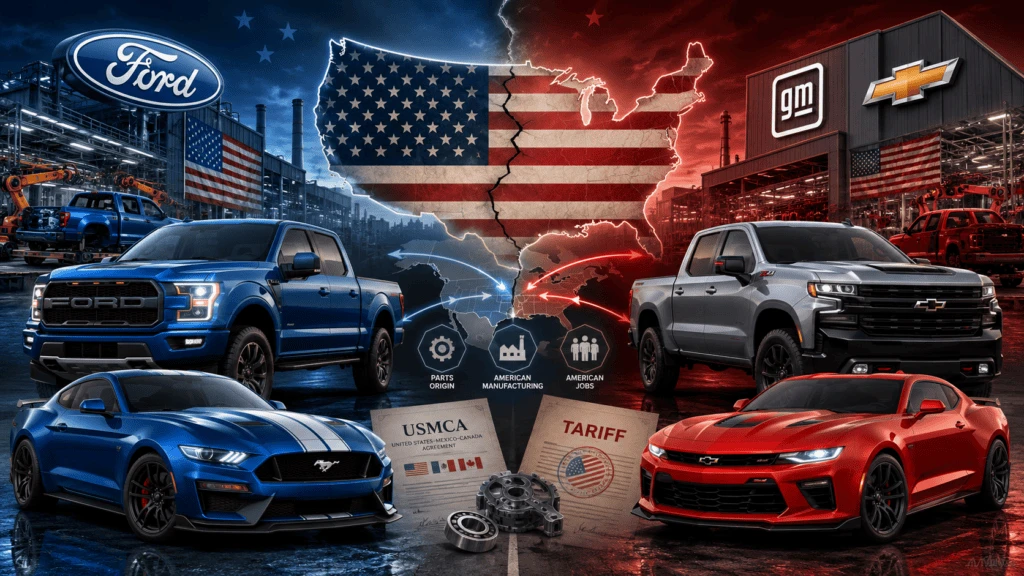
Ford and GM are battling to be the most American automaker as tariffs turn factory jobs, parts sourcing and investment into weapons.
Detroit’s Old Rivalry Has a New Battleground
Ford versus Chevrolet is one of America’s oldest automotive arguments. F-150 versus Silverado. Mustang versus Camaro. Blue Oval versus Bowtie. Now Ford and General Motors are fighting over something much bigger than horsepower or sales: which company deserves to call itself America’s automaker.
The argument matters because “American” has suddenly become valuable currency. Tariffs, trade negotiations and proposed changes to the United States-Mexico-Canada Agreement are forcing automakers to defend where they build vehicles, where their parts originate and how many Americans they employ. The USMCA automotive rules require substantial North American content for qualifying vehicles.
Ford vs GM Fight to be The Most American Manufacturer
Ford has a straightforward pitch. It says it assembles more vehicles in the United States and employs more hourly manufacturing workers here than any other automaker. GM counters with the enormous scale of its American economic footprint, investment, facilities and employment. Both have a case. Neither tells the whole story.
You may also enjoy: The Most American Cars? Not Who You Think
Ford Has a Powerful Made-in-America Argument
Ford’s strongest evidence is surprisingly simple: factories and workers. The company says it employs about 57,000 hourly manufacturing workers in the United States, more than any other automaker. Ford also says it assembled more than 1.8 million vehicles domestically in 2023, based on S&P Global Mobility data, and nearly 80 percent of the Ford vehicles sold in America were assembled here.
That includes some enormously important products. F-Series trucks sold in the United States are assembled domestically, while vehicles including Bronco, Ranger and Mustang also come from American plants. The importance of manufacturing employment goes well beyond assembly plants; the Bureau of Labor Statistics tracks manufacturing employment across the broader American economy.
Ford vs GM Fight to be The Most American Manufacturer
Ford is now strengthening that position. The company recently announced plans to shift Lincoln production for the U.S. market from China to American factories. CEO Jim Farley acknowledged that tariffs helped change Ford’s thinking. There is an obvious political advantage to saying, “We build more here,” but assembly plants also support suppliers, transportation companies, local businesses and thousands of families.
You may also enjoy: Most American-Made Cars You Want
GM Says America Is Bigger Than an Assembly Line
General Motors can play the same game with different numbers. GM says it has invested approximately $60 billion in the United States since 2020 and operates 50 assembly and parts facilities across 19 states. The company says one in 10 U.S. autoworkers is a GM employee and that its operations directly contributed $50 billion to U.S. GDP in 2024.
The manufacturing map is substantial. GM builds Silverado and Sierra pickups in Indiana and Michigan, full-size SUVs in Texas, crossovers in Michigan and other vehicles across an extensive American manufacturing network. The Bureau of Economic Analysis provides the broader economic framework for understanding how manufacturing contributes to U.S. output.
Ford vs GM Fight to be The Most American Manufacturer
GM is continuing to spend. It announced roughly $157 million for modernization at Wentzville Assembly in Missouri in July, part of more than $430 million announced across that plant and Spring Hill, Tennessee, in about a month. So GM’s argument becomes broader: should “most American” mean the company assembling the greatest number of vehicles here, or the company with the largest overall economic contribution, engineering base, supplier spending and capital investment?
You may also enjoy: Which Automakers Are Building U.S. Factories to Dodge Trump’s Tariffs?
What Does “American-Made” Actually Mean?
This is where the flag waving collides with the window sticker. The National Highway Traffic Safety Administration requires new passenger vehicles to disclose U.S./Canadian parts content under the American Automobile Labeling Act. The label also identifies the final assembly location and countries of origin for the engine and transmission.
Notice the problem: U.S. and Canadian parts are combined in that percentage. A vehicle can therefore be assembled in Michigan using components from Canada, Mexico, Asia and Europe. A Japanese or Korean badge can simultaneously sit on a vehicle assembled by American workers using significant North American content. Buyers can also use NHTSA’s VIN decoder to identify a vehicle’s reported manufacturing plant and country.
Ford vs GM Fight to be The Most American Manufacturer
The federal government’s USMCA rules add another definition. Current rules generally require 75 percent North American regional value content for passenger vehicles and light trucks to qualify under the agreement, along with additional requirements involving core parts, steel, aluminum and labor. There isn’t one magic number establishing how American a car is.
You may also enjoy: Hyundai’s Savannah Surge: How a Korean Giant Is Rewriting America’s Automotive Future
Tariffs Turn Patriotism Into Money
This might have remained corporate chest-thumping if billions of dollars weren’t involved. Detroit automakers are lobbying Washington over potential changes to North American trade rules. One proposal reported by Reuters would require at least 50 percent U.S.-made content for vehicles to receive lower tariffs while also increasing the existing North American content requirement.
Estimates from two automakers cited by Reuters suggest those changes could add at least $2 billion annually in costs for each Detroit automaker. Meanwhile, GM expects gross tariff-related expenses of roughly $2.5 billion to $3.5 billion this year. Ford has estimated its net tariff impact at about $1 billion.
Ford vs GM Fight to be The Most American Manufacturer
That explains why the definition of American manufacturing is suddenly worth fighting over. A rule favoring domestic assembly can benefit one company. A rule emphasizing component sourcing, batteries or particular countries can benefit another. Even the phrase “Made in USA” has specific federal meaning: the Federal Trade Commission explains its U.S.-origin standard and notes that automobiles have separate content-disclosure requirements.
You may also enjoy: Honda Passport and Acura Integra Type S Head to Japan From US
The Foreign Automakers Complicate Everything
There is another uncomfortable wrinkle for Detroit: some supposedly foreign automakers are deeply American. Honda builds vehicles in states including Ohio, Indiana and Alabama. Toyota manufactures in Kentucky, Indiana, Texas and elsewhere. Hyundai has poured billions into Georgia. BMW’s South Carolina operation is a major production and export hub.
That makes the old shorthand increasingly useless. A vehicle wearing a Japanese badge may employ American assembly workers, contain substantial North American content and roll out of an American factory. Meanwhile, a model carrying a Detroit nameplate may be assembled in Mexico or Canada with globally sourced components.
Ford vs GM Fight to be The Most American Manufacturer
We have written about this before at Test Miles because shoppers increasingly need to look beyond the emblem on the grille. The passport of the corporation and the birthplace of the vehicle are no longer necessarily the same thing.
So Who Is the Most American Automaker?
Ford probably wins if your definition emphasizes the number of vehicles assembled domestically and hourly U.S. manufacturing workers. Those are tangible measurements, and Ford has built its argument around them effectively. GM has an equally serious claim if the definition expands to total American investment, facilities, employment and overall economic contribution. Sixty billion dollars of U.S. investment since 2020 is difficult to dismiss.
But perhaps the most useful answer is that the question itself has become outdated. Modern automobiles are among the most complicated internationally sourced consumer products Americans buy. Engines, transmissions, semiconductors, batteries, steel, software and thousands of individual components can cross borders before a completed vehicle reaches a dealership.
Ford and GM can continue fighting over who gets to plant the largest flag outside the factory. For shoppers who genuinely care about buying American, however, there is a better approach: ignore the badge for a moment and read the label. Where was the vehicle assembled? Where were its engine and transmission made? What percentage of its parts comes from the United States and Canada?
The answers may tell you more about how American your next car really is than the company name stamped across its grille.