Hyundai’s Coolest Tiny EVs Are Staying in India
By Robert R Guio
The Hyundai TVS electric three-wheeler shows how local design, Indian manufacturing and commercial EV economics are reshaping small urban mobility.
Some of the most revealing vehicles in Hyundai’s future product plan are not the ones with the biggest batteries, the most horsepower or the longest option sheets. One of them has three wheels, a tiny footprint and a job description that could include taxi, delivery van and emergency vehicle.
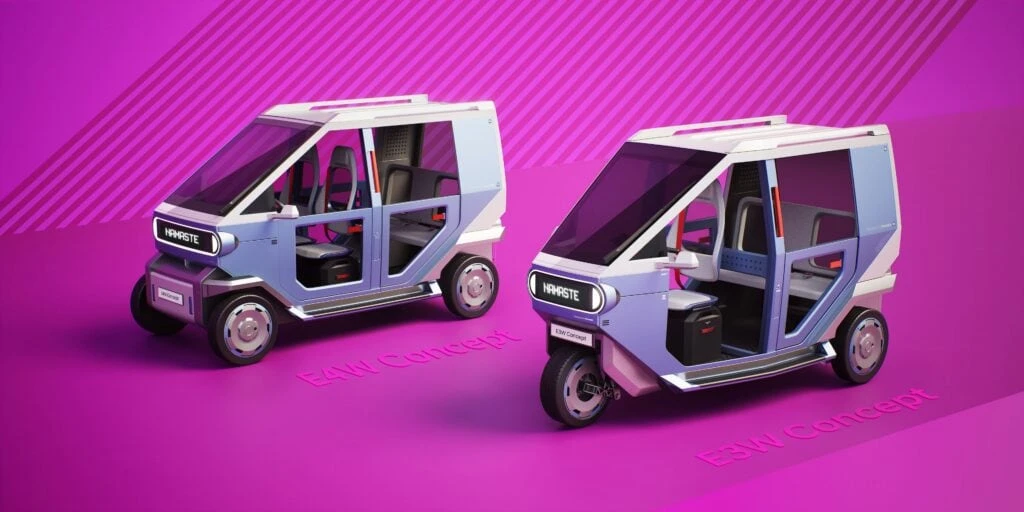
Hyundai first showed its electric three-wheeler and micro four-wheeler concepts during the January 2025 Bharat Mobility Global Expo. At that stage, the company was studying a possible partnership with TVS Motor Company. The language was intentionally cautious. There was no binding agreement, and the four-wheeler was already described as a separate idea whose global potential still needed review.
Hyundai x TVS Bring Three-Wheel Mobility to India, Sorry USA.
That status has changed. By April 2026, the two companies had formalized the project through a Joint Development Agreement. Its scope includes developing and commercializing the vehicle for the Indian market, with other countries also in view. Hyundai will lead design and co-development. TVS brings an electric three-wheeler platform, local engineering experience, manufacturing and sales capability. The companies say the program has moved toward testing, localization, certification and mass production.
That makes this more than an unusual concept-car story. It is a useful example of where Hyundai appears to be heading as a global manufacturer: design vehicles around regional problems, localize the supply chain, and stop assuming that every important EV needs to look like a conventional passenger car.
Why the Hyundai TVS electric three-wheeler matters
The easy way to dismiss a vehicle like this is to call it a modernized auto rickshaw and move on. That misses the scale of the market. The International Energy Agency’s Global EV Outlook 2026 identifies India as the leading national market for electric three-wheelers in 2025. Sales rose to almost 800,000 units, and electric models represented nearly 70 percent of all three-wheeler sales in the country.
In other words, Hyundai is not trying to persuade India that an electric three-wheeler is a sensible idea. The market has largely answered that question already. The harder task is making one that earns its place as a working vehicle. Commercial customers tend to be unsentimental. They care about acquisition cost, energy cost, uptime, parts availability, payload, charging time, durability and how much money a vehicle can make during a shift.
Hyundai x TVS Bring Three-Wheel Mobility to India, Sorry USA.
India’s policy environment has helped accelerate electrification. Through the government’s PM E-DRIVE program, incentives have targeted electric two-wheelers, three-wheelers and other zero-emission transport. By January 2026, the government reported 293,000 electric three-wheelers sold under the program. Support for the larger L5 category reached its target ahead of schedule.
That combination of large volume and cost-sensitive commercial buyers should force discipline into the project. A clever hinge or dramatic light signature will not rescue a vehicle that is expensive to repair or unavailable when the morning rush begins.
You may also enjoy: The Korean Blueprint: How Hyundai and Kia Quietly Rewrote the Rules of Car Building
The cleverest feature is aimed at the road beneath it
Hyundai’s original concept contains several ideas that make more sense when viewed as responses to Indian operating conditions rather than styling flourishes.
The body can be raised to negotiate waterlogged streets during heavy monsoon rain. Large tires are intended to make rough roads less punishing. A towing hook provides a straightforward recovery point if the vehicle becomes stuck. Hyundai also studied water-resistant cabin materials and heat-reducing roof paint for a climate where heat and rainfall are not occasional inconveniences.
That is the kind of regional engineering I want to see more often. Automakers love the phrase “global vehicle,” but a product designed to satisfy everyone can end up optimized for nobody. Hyundai’s three-wheeler takes the opposite route. It starts with a narrow set of difficult daily conditions and attempts to solve them directly.
Hyundai x TVS Bring Three-Wheel Mobility to India, Sorry USA.
The concept also uses an angled windshield intended to improve forward visibility and collision protection, plus a flat floor and extended wheelbase designed to create a better driving position and more interior room. There is a foldable seat to accommodate a wheelchair user, adaptable storage, a phone holder, a slim information display and pegboard-like interior panels that can be configured around the job.
The current Central Motor Vehicles Rules published by India’s Ministry of Road Transport and Highways define the regulatory framework for battery-operated vehicles, while the production model will still have to complete the specific testing and certification required for its category. That matters because Hyundai’s language about improved protection is a design claim, not evidence of a completed crash program.
You may also enjoy: 2026 Hyundai Ioniq 5 Review: The Value Is Back
Localization is the business case, not a footnote
The most important part of the 2026 agreement may be the least glamorous: local sourcing.
Hyundai and TVS say the vehicle is being engineered specifically for Indian conditions, with TVS expected to handle local sales and use its manufacturing operations for Indian demand and potential exports. That should help with cost, parts supply and service response, three areas that matter enormously when the vehicle is a source of income rather than a weekend toy.
This also fits Hyundai’s broader strategy. At its 2026 CEO Investor Day, the company said it plans 26 launches or refreshes in India by 2030, intends to add 320,000 units of Indian manufacturing capacity and is targeting 90 percent local vehicle content by 2030. Hyundai also describes India as an increasingly important export base.
Hyundai x TVS Bring Three-Wheel Mobility to India, Sorry USA.
The NITI Aayog India Electric Mobility Index provides useful context for why localization matters. India has a huge domestic three-wheeler industry, and the country’s EV transition is tied closely to domestic manufacturing, state policy, charging access and commercial economics. A three-wheeler supported by a local supply base is more than a way to avoid shipping costs. It can make parts easier to obtain, shorten repair cycles and reduce exposure to currency and import-cost swings.
That is a different version of the same localization story Hyundai is telling in the United States. In Georgia and Alabama, local production is about scale, supply security and market fit. In India, the economic threshold is even less forgiving because the vehicle itself must stay affordable enough to work as a business asset.
You may also enjoy: Hyundai’s Savannah Surge: How a Korean Giant Is Quietly Rewriting America’s Automotive Future
The four-wheeler is still the wildcard
The three-wheeler is moving forward, but Hyundai’s tiny four-wheeler may ultimately tell us just as much about where small urban vehicles could go next.
When both concepts appeared in 2025, Hyundai positioned the three-wheeler as the one most likely to move forward with TVS. The micro four-wheeler, by contrast, was still being evaluated for possible global use. The April 2026 development agreement centered on the three-wheeler and did not announce a production plan for the micro four-wheeler.
That is worth keeping straight. A concept displayed beside a vehicle headed toward commercialization does not automatically inherit the same status. Hyundai has not announced a battery capacity, output, range, price, market list or launch date for the four-wheeler.
Hyundai x TVS Bring Three-Wheel Mobility to India, Sorry USA.
Still, its basic premise is compelling. Dense cities contain huge numbers of trips where riders need weather protection and useful carrying space beyond a scooter, yet have no need for the width, mass or parking footprint of a conventional SUV. Campus fleets, resorts, delivery companies, municipal services and dense urban neighborhoods are obvious use cases if regulations and economics allow them.
The broader electric-mobility question is whether charging infrastructure needs to grow in the same way for every kind of EV. The IEA’s analysis of EV charging shows India expanding public charging, but small commercial vehicles can also benefit from predictable routes and overnight or depot charging. A three-wheeler that returns to the same base every day has a different energy problem from a family EV expected to cross several states on vacation.
You may also enjoy: Hyundai’s U.S. Momentum: Five Years Of Growth And A $26 Billion Bet
What fleet buyers should demand before launch
The concept is thoughtful, but there is still a large blank space where the purchasing spreadsheet should be.
Hyundai and TVS have not disclosed battery capacity, usable range, motor output, charging power, charging time, payload, passenger capacity, curb weight, battery warranty, expected service intervals, production volume or retail price. There is also no firm public sale date in the material reviewed for this story. Those are not small details. They determine whether an electric three-wheeler is a practical tool or an expensive experiment.
Range deserves especially careful treatment. For a commercial three-wheeler, an enormous battery can be counterproductive if it raises purchase price, weight and charging time beyond what the daily route requires. The better question is how much reliable range the vehicle provides under heat, rain, payload and repeated stop-and-go use, and how quickly it can return to work.
Hyundai x TVS Bring Three-Wheel Mobility to India, Sorry USA.
Durability is another major test. Adjustable ride height sounds excellent when a monsoon has turned a street into shallow water, but the mechanism must survive years of dust, water, potholes and constant loading. Water-resistant materials are useful, but electrical connectors, battery sealing and thermal management will matter even more. The same skepticism should be applied to safety. Improved visibility and collision protection are worthwhile design goals, but buyers should wait for certification data and production specifications before treating them as demonstrated results.
There is also a regulatory distinction worth understanding. India’s rules separate different three-wheeler categories by performance and use, including the L5 class. Readers interested in the classification can consult the Ministry of Road Transport and Highways definition of Category L5. The exact category and homologated specifications of the Hyundai-TVS production vehicle will matter for how it is certified and used.
You may also enjoy: Move Over Jeep and Ford: Hyundai Plotting $26B Offensive
The larger lesson is easy to miss because the vehicle is so small. Hyundai is using the same strategic muscles here that large automakers use on billion-dollar passenger-car programs: local engineering, platform sharing, supply-chain localization, regulation, software and a clear use case. The difference is that every unnecessary kilogram and every unnecessary dollar matter more.
If Hyundai and TVS can turn the clever parts of the concept into durable, affordable production hardware, the electric three-wheeler could become one of Hyundai’s most consequential vehicles without ever appearing in an American showroom. It is aimed at a market already moving rapidly toward electric propulsion, and it is being developed around the unglamorous details that decide whether transportation actually works.
That is a far more interesting story than simply putting a Hyundai badge on a rickshaw.