The Election Is Over. Now What Happens to Housing?
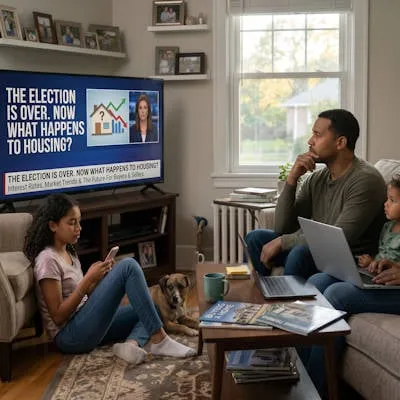
The votes have been cast. The political landscape has changed. But for millions of Americans hoping to buy or sell a home, one question remains: Will the election make housing more affordable?
The answer is not as simple as which political party controls Congress.
Democrats won control of both the House and Senate in the November 3 midterm elections, establishing divided government for the remaining two years of President Donald Trump’s term.
For homebuilders, Realtors, homeowners, and prospective buyers, the election introduces a new political environment into a housing market already struggling with affordability, mortgage rates, and hesitant consumers.
The election has changed Washington. It has not changed the monthly mortgage payment.
Mortgage Rates: The Number That Matters Most
According to Freddie Mac, the average 30-year fixed mortgage rate stood at 7.24% on October 29, compared with 6.17% a year earlier.
Consider a buyer financing $400,000 with a 30-year mortgage.
At 7.24%, the monthly principal and interest payment is approximately $2,728. At 6%, that payment falls to approximately $2,398.
That’s a difference of nearly $330 a month, or almost $4,000 annually.
No election result automatically produces that savings.
Mortgage rates respond to inflation, Federal Reserve policy, Treasury yields, and financial-market expectations. Congressional decisions can influence those conditions, but neither Congress nor the president directly controls mortgage rates.
For housing to experience a sustained recovery, purchasing power must improve.
New Construction: Builders Are Already Responding
The National Association of Home Builders reported that builder confidence fell to 29 in October, the lowest reading since June 2012.
Even more revealing, 65% of builders reported using sales incentives, while 43% reduced home prices. Among builders cutting prices, the average reduction was 6%.
New single-family home sales declined to a seasonally adjusted annual rate of 676,000 in September, down 5.3% from a year earlier.
Builders face difficult choices.
They can reduce prices, offer mortgage-rate buydowns, contribute toward closing costs, or delay construction. Every option affects profitability.
Yet builders possess one advantage that individual resale sellers often lack: the ability to coordinate financing incentives through preferred lenders and spread marketing costs across multiple homes.
That advantage could become increasingly important.
Resales: A Different Set of Problems
The resale market faces its own challenges.
According to the National Association of Realtors, existing-home sales increased 1.5% in September from August but remained 2.2% below September 2025 levels.
The annualized sales pace was 3.99 million homes, with 1.60 million properties available, representing 4.8 months of inventory.
The median existing-home price reached $417,500, up 1.3% from the previous year.
These figures suggest a market that is neither collapsing nor strongly recovering.
But resale sellers confront a particularly difficult situation.
Many homeowners took out mortgages at rates below 4% in earlier years. Selling their current homes and purchasing another at rates above 7% can substantially increase their monthly housing expenses.
Consequently, some owners who might otherwise move are staying put.
This mortgage-rate lock-in effect restricts the supply of resale homes and limits opportunities for move-up buyers.
Meanwhile, homeowners who must sell because of relocation, retirement, divorce, or financial circumstances may face increasingly selective buyers.
The Competition Between New Homes and Resales
Consider two comparable homes listed for $450,000.
One is newly constructed. The other is a resale.
The builder offers an attractive financing package, closing-cost assistance, a new-home warranty, and the opportunity to move into a property without immediate maintenance concerns.
The resale seller offers an established neighborhood, mature landscaping, and perhaps a more desirable location.
Which home does the buyer choose?
That depends on the property, but financing can become the deciding factor.
A builder willing to sacrifice some margin to close a sale may offer a financial package that a resale seller cannot economically duplicate.
This places new pressure on Realtors representing resale properties.
Their responsibility increasingly involves explaining not simply the asking price, but the total cost of ownership and the financial advantages of competing properties.
Buyers don’t purchase interest rates. They purchase homes they believe they can afford.
What Does Divided Government Mean for Housing?
The incoming Democratic Congress will have opportunities to propose changes involving housing affordability, tax policy, federal spending, construction costs, and assistance for first-time buyers.
But President Trump retains veto power.
Unless legislation receives presidential approval, Congress generally needs a two-thirds vote in both chambers to override a veto.
That makes substantial bipartisan housing legislation harder, though not impossible.
Congress could consider incentives for homebuyers, programs encouraging additional housing construction, and measures addressing development costs.
However, affordability programs must be evaluated carefully. Increasing purchasing power without increasing housing supply could add upward pressure to home prices.
The crucial question is whether Washington can improve affordability without unintentionally making homes more expensive.
Every Qualified Buyer Matters More Than Ever no There is another consequence of today’s housing market that deserves serious attention.
When qualified buyers are plentiful, losing a prospective sale may seem like a temporary disappointment. Another buyer may be right around the corner.
But when qualified buyers are scarce, every missed opportunity costs more.
For homebuilders, resale sellers, and Realtors, the business imperative is no longer simply generating more prospects. It is becoming more effective at converting qualified prospects into satisfied homeowners.
That requires more than showing properties, explaining features, or answering questions.
It requires understanding what is preventing a qualified buyer from making a purchasing decision, addressing legitimate concerns, and providing the confidence needed to move forward.
A buyer who says, “We think we’ll wait,” may not be rejecting the home. That buyer may be expressing uncertainty about interest rates, affordability, or making a major financial commitment.
Recognizing and addressing those concerns can make the difference between a completed sale and another qualified prospect walking away.
In a market where qualified buyers are increasingly valuable, improving sales conversion is no longer simply a competitive advantage. It is a business imperative.
The Election Is Over. The Housing Challenge Isn’t.
For buyers, today’s market offers opportunities to negotiate prices, financing incentives, and other purchase terms.
For resale sellers, realistic pricing and a clear understanding of competing new construction have become increasingly important.
For builders, maintaining sales velocity while protecting profit margins remains a significant management challenge.
And for Realtors, understanding financing, recognizing buying objections, and guiding qualified prospects toward informed purchasing decisions has never been more important.
The election may influence housing policy for years, but its immediate impact on home sales will likely be limited.
Ultimately, the housing market’s direction will depend on affordability, mortgage rates, inventory, and consumer confidence.
The election has decided who will govern. The housing market will be decided by who can afford to buy, who is willing to sell, and who can bring the two together.
—
**About the Author**
David Fletcher is a longtime new-home sales specialist and real estate industry commentator whose career includes working with onsite sales teams responsible for more than $3 billion in new-home sales.
—