The Roth Conversion Trap: Saving on Taxes Can Still Raise Your Medicare Costs
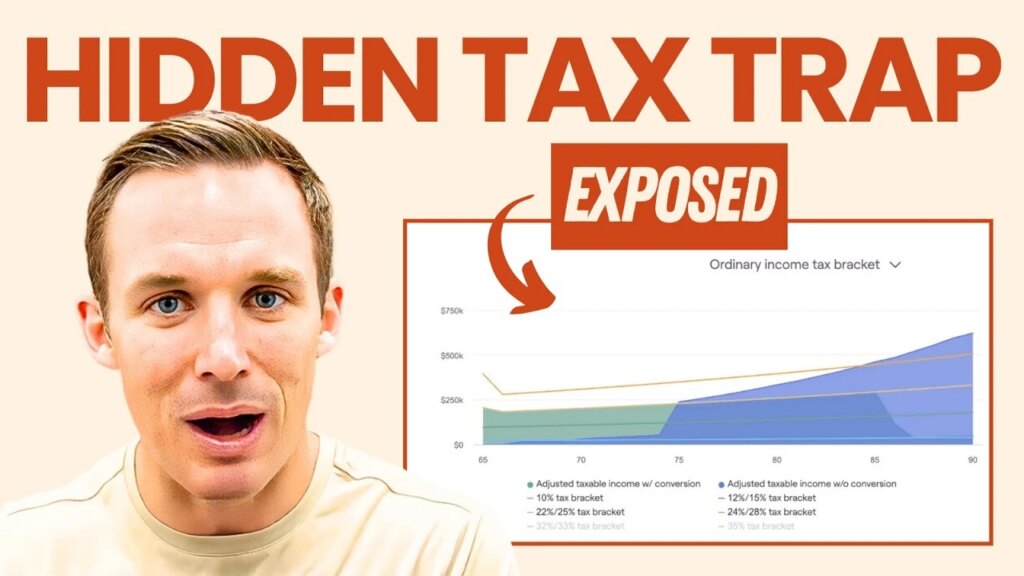
Roth conversions are often presented as one of the cleanest ways to reduce taxes in retirement. Move money from a traditional IRA into a Roth while tax rates are relatively low, pay the tax today and allow the converted assets to grow in an account whose qualified withdrawals can generally be tax-free. For retirees facing large future required minimum distributions, that can be an excellent strategy, but the calculation becomes much more complicated once Medicare premiums, Social Security taxation and capital gains are included.
The biggest mistake is assuming the objective should be filling an ordinary-income tax bracket as completely as possible. A retiree might decide to convert enough each year to reach the top of the 12% or 22% bracket because paying that rate today appears preferable to facing a higher rate later. Yet a conversion changes modified adjusted gross income, and that same income can push the retiree across a Medicare IRMAA threshold or make additional Social Security benefits taxable. The federal tax bracket is therefore only one of several boundaries that determine what the next conversion dollar actually costs.
A better strategy evaluates the household’s total marginal cost before deciding how much to convert. Sometimes that means filling a tax bracket completely, but in other years the economically superior stopping point can be a few thousand dollars below a Medicare threshold. The purpose of the conversion is not to maximize the amount transferred to Roth; it is to maximize the household’s expected after-tax wealth over retirement.
Roth Conversions Work Best When Today’s Tax Rate Is Favorable
A Roth conversion causes previously untaxed traditional IRA or retirement-plan money to become taxable in the year of conversion. The benefit comes later, when the assets have moved into a Roth environment and qualified withdrawals can generally be taken without federal income tax. The strategy works best when the rate paid on the conversion is lower than the rate the household would otherwise face on the same money in the future.
For 2026, married couples filing jointly remain in the 12% federal bracket through $100,800 of taxable income, the 22% bracket through $211,400 and the 24% bracket through $403,550. Single filers remain in the 12% bracket through $50,400, the 22% bracket through $105,700 and the 24% bracket through $201,775. Those ranges can create substantial conversion opportunities after wages disappear, particularly during the years before Social Security and required minimum distributions add more income.
The mistake is treating those brackets as automatic targets. A retiree who reaches $210,000 of taxable income and sees another $1,400 of room in the 22% bracket may believe converting exactly that amount is obviously efficient, but taxable income is not the only number controlling retirement costs. Medicare looks at modified adjusted gross income rather than taxable income, and capital gains and other items can interact with the calculation differently.
That means the correct question is not simply, “How much room is left in my tax bracket?” The better question is, “What happens to every other part of my financial life if I recognize another $10,000 of income this year?”
Medicare Creates Tax Cliffs That Ordinary Brackets Do Not
Medicare’s Income-Related Monthly Adjustment Amount, commonly called IRMAA, applies to higher-income beneficiaries enrolled in Part B and Part D. Unlike federal income-tax brackets, where only the dollars above a threshold move into the higher rate, IRMAA generally works in income tiers. Crossing a threshold can increase the beneficiary’s Medicare premium for the year rather than merely applying a higher rate to the last few dollars of income.
For 2026, the standard Part B premium is $202.90 per month. The first IRMAA tier begins when modified adjusted gross income exceeds $109,000 for a single filer or $218,000 for a married couple filing jointly, increasing the Part B premium to $284.10 per person per month. Higher tiers begin above $137,000, $171,000 and $205,000 for single filers and above $274,000, $342,000 and $410,000 for married couples, with the highest 2026 Part B premium reaching $689.90 per month.
Part D has its own IRMAA surcharge in addition to the beneficiary’s drug-plan premium, so crossing an income threshold can affect both components of Medicare. CMS estimates that about 8% of Part B and Part D beneficiaries pay income-related adjustments, making the surcharge a relatively concentrated but meaningful issue for higher-income retirees.
This creates a very different marginal-cost structure from the federal tax code. A retiree can convert what appears to be a small additional amount and discover that the income increase pushed one or both spouses into a higher Medicare tier, creating hundreds or thousands of dollars of additional premiums.
One Extra Dollar Can Be More Expensive Than It Looks
Suppose a married couple expects modified adjusted gross income of $216,000 before a Roth conversion. They decide to convert another $5,000 because they still have room within the 22% ordinary-income bracket, bringing MAGI to roughly $221,000 under a simplified example.
For federal income taxes, only the conversion itself creates additional taxable income at the applicable marginal rate. Medicare operates differently. Because the couple has moved above the $218,000 2026 joint IRMAA threshold, both spouses could become subject to the first Part B income-related surcharge, increasing each person’s monthly Part B premium from $202.90 to $284.10.
That represents an additional $81.20 per person per month, or nearly $1,949 annually for a couple, before including any additional Part D IRMAA. Suddenly the last $5,000 conversion did not merely cost the ordinary income tax on $5,000; it also contributed to a Medicare premium increase that can materially raise the effective cost of the transaction.
This does not automatically mean the couple should stop at $217,999. A conversion that saves far more in future taxes can still be worthwhile despite the surcharge, but the surcharge belongs in the analysis. Ignoring it makes a conversion look cheaper than it really is.
IRMAA Usually Looks Back Two Years
Another reason the surcharge surprises retirees is the delay between the conversion and the Medicare bill. Social Security generally determines IRMAA using tax information supplied by the IRS from two years before the Medicare premium year.
A Roth conversion completed in 2026 can therefore affect Medicare premiums in 2028 rather than generating an obvious healthcare bill immediately. That lag makes it easy to forget the connection, particularly when the conversion was part of a broader tax-planning strategy several years earlier.
The two-year lookback also means retirement can create temporary mismatches. Someone earning a high salary before retirement may enter Medicare with IRMAA based on income that no longer reflects current circumstances, while someone completing a very large conversion after retirement can deliberately create a higher future premium year even though regular spending income remains modest.
Certain life-changing events can support a request for Social Security to make a new IRMAA determination when household income falls significantly. Qualifying situations include events such as work stoppage, work reduction, marriage, divorce and the death of a spouse. A voluntary Roth conversion itself is not simply erased because the resulting Medicare surcharge is inconvenient, so conversions should generally be planned with the future premium year in mind.
A Conversion Can Also Trigger the Social Security Tax Torpedo
Medicare is not the only hidden marginal cost. Retirees already receiving Social Security can experience another tax interaction when additional income causes more of their benefits to become taxable.
The IRS calculation generally considers one-half of Social Security benefits plus most other income, including tax-exempt interest. When this combined income rises above certain thresholds, an increasing portion of Social Security becomes taxable, with as much as 85% of benefits eventually included in taxable income. For married couples filing jointly, the higher commonly referenced threshold is $44,000, while for many single filers it is $34,000.
The important point is that 85% taxable does not mean an 85% tax rate. It means up to 85% of the Social Security benefit can be included in taxable income, where ordinary federal rates then apply.
A Roth conversion can therefore create more taxable income than the conversion amount alone suggests. Another $10,000 converted from an IRA may cause some Social Security benefits that were previously excluded from taxable income to become taxable, pushing the effective marginal rate on that conversion above the advertised tax bracket.
Capital-Gain Harvesting Can Compete With Roth Conversions
Retirees with taxable brokerage accounts face another tradeoff. The same low-income years that create attractive Roth-conversion opportunities can also create the ability to realize long-term capital gains at a 0% federal rate.
For 2026, the 0% long-term capital-gains rate generally applies up to $98,900 of taxable income for married couples filing jointly and $49,450 for most single filers. The 15% capital-gains range extends above those amounts until substantially higher taxable-income thresholds are reached.
A Roth conversion increases ordinary taxable income and can therefore consume room that otherwise could have been used to harvest appreciated investments at 0%. A retiree who automatically fills the 22% bracket with conversions may unintentionally push capital gains that could have been recognized tax-free into the 15% bracket.
That does not mean tax-gain harvesting always beats a Roth conversion. Someone with a $3 million traditional IRA and relatively modest taxable gains may have a much larger future problem in the IRA. Another household with limited pretax assets and enormous embedded brokerage gains may reasonably prioritize capital-gain harvesting instead.
Paying More Tax Today Has an Opportunity Cost
Roth conversion analysis frequently focuses on the taxes avoided later while giving insufficient attention to the taxes paid today. Those current taxes have to come from somewhere, and the assets used to pay them could otherwise remain invested.
Suppose a retiree completes a $100,000 conversion and pays $22,000 of federal tax under a simplified 22% marginal-rate example. If that $22,000 comes from a taxable brokerage account, the Roth receives the full $100,000, but the household has $22,000 less available to invest elsewhere.
If that outside money could have compounded for another 20 years, its foregone growth becomes part of the cost of converting. The comparison therefore needs to measure total household wealth rather than simply showing a traditional IRA shrinking and a Roth account growing.
This is one reason an unnecessary conversion can become surprisingly expensive over decades. Paying a higher rate today than the retiree would have faced later not only produces excess tax; it also eliminates the future investment return that tax money could have generated.
Avoiding Every IRMAA Tier Can Be a Mistake Too
Once retirees learn about IRMAA, the pendulum can swing too far in the opposite direction. They begin treating each Medicare threshold as a wall that should never be crossed, even when converting above it could reduce much larger future taxes.
Imagine a couple with a very large traditional IRA and projected future RMDs that could push them into the 32% bracket. If converting an additional $50,000 today at 24% causes a temporary Medicare surcharge of several thousand dollars, the strategy may still improve lifetime wealth if that conversion prevents the same money from eventually facing a materially higher tax rate.
The calculation should therefore compare the surcharge with the benefit created by the conversion. Paying $3,000 of additional Medicare premiums to save $15,000 of expected lifetime tax can be perfectly rational.
IRMAA should be treated as another marginal cost, not as a prohibition. The most efficient conversion amount may fall just below a Medicare threshold in one year and deliberately cross it in another year when much more pretax income needs to be moved.
The Right Stopping Point Can Be Different Every Year
Retirement tax planning works poorly on autopilot because the household’s income changes. One year may include large charitable deductions, another may involve a major capital gain and another may have unusually low income after work ends but before Social Security starts.
The conversion amount should therefore be recalculated annually. A retiree might fill the 12% bracket during one year, convert well into the 22% bracket during another and deliberately stop short of an IRMAA threshold during a third.
Market conditions can also influence timing. When assets inside a traditional IRA fall substantially, converting the same number of shares produces less taxable income, allowing more of the investment to move into Roth at a depressed valuation.
This flexibility is one of the greatest advantages of multiyear planning. A retiree does not need to solve the entire tax problem in one transaction, and attempting to do so can create unnecessarily large taxes and healthcare costs.
Widowhood Can Make Today’s Conversion More Valuable
Married couples also need to consider what happens when one spouse dies. The surviving spouse typically moves from married filing jointly to single tax brackets, while much of the household’s traditional retirement wealth may remain.
That can create a substantial tax squeeze. In 2026, the 22% bracket for married couples filing jointly extends through $211,400 of taxable income, while for single filers it ends at $105,700. Medicare’s first IRMAA threshold also drops from $218,000 for married couples to $109,000 for single beneficiaries.
A surviving spouse can therefore face higher marginal tax rates and Medicare premiums even when household income falls after the first spouse’s death. Conversions completed while both spouses are alive and using wider joint brackets can reduce the traditional balance that later lands on the survivor’s return.
This is one reason stopping every conversion merely to avoid a current IRMAA tier can be shortsighted. The temporary surcharge today may be worth paying if it materially reduces decades of higher taxation for the surviving spouse.
Heirs Can Change the Conversion Decision
Legacy planning adds another layer because large traditional retirement accounts can eventually transfer a tax liability to children. Many nonspouse beneficiaries must distribute inherited retirement accounts within a limited period under current rules, which can concentrate taxable income during the heirs’ working years.
A parent who could convert traditional money at 22% or 24% during retirement may therefore be comparing that rate not only with their own future RMD tax rate but also with the rate an adult child could face when inherited distributions arrive on top of salary.
Roth assets can still be subject to beneficiary distribution requirements, but qualified withdrawals generally do not produce the same ordinary-income tax burden. That can make a conversion more valuable for a household whose primary objective is leaving an after-tax inheritance rather than spending every dollar during retirement.
The analysis should nevertheless avoid assuming that heirs will certainly face higher taxes. Beneficiary age, income, tax law and the amount ultimately inherited can all change, so a strong plan tests several scenarios rather than building the entire conversion strategy around one predicted future bracket.
Software Is Useful Only When It Models the Right Things
Roth-conversion software can make these interactions easier to evaluate, but sophisticated output is only as useful as the assumptions underneath it. A projection that considers ordinary federal taxes while ignoring Medicare IRMAA, Social Security taxation, state taxes and capital-gain interactions can recommend a conversion amount that looks optimal only because important costs were excluded.
The model should compare total household wealth under multiple scenarios over time. It should account for the conversion tax paid from outside assets, future RMDs, Medicare premiums, Social Security, investment growth and the tax characteristics of what heirs eventually receive.
It should also calculate marginal outcomes rather than simply comparing two enormous ending-net-worth numbers. Seeing that another $10,000 conversion saves $2,000 of future taxes but creates $3,000 of additional Medicare costs is far more actionable than knowing one 30-year scenario ends with $50,000 more than another.
The purpose of software is not to produce a precise answer to the dollar. It is to expose the interactions that are difficult to see by looking at a standard tax return.
The Best Roth Conversion Is Not Necessarily the Biggest One
Roth conversions remain one of the most powerful tools available to retirees with substantial pretax savings. They can reduce future RMDs, create tax-free flexibility and help protect surviving spouses and heirs from concentrated taxable income later.
Their effectiveness comes from paying tax at the right time, not simply paying tax earlier. A conversion that appears inexpensive inside the 12% or 22% bracket can become more costly once Medicare IRMAA, Social Security taxation and lost capital-gain opportunities are included.
The optimal stopping point may therefore sit below an ordinary tax-bracket ceiling. In one year, it may be efficient to stop just under an IRMAA threshold, while in another year the long-term benefit of crossing that threshold may justify the temporary surcharge. The answer changes with account balances, market returns, filing status, Social Security and future spending needs.
That is why Roth conversion planning should be measured in lifetime after-tax wealth rather than the size of the Roth account. Moving more money into Roth is not inherently a victory if the household overpaid taxes and Medicare premiums to accomplish it. The winning strategy is the one that leaves the retiree with the greatest financial flexibility after every cost not merely the smallest traditional IRA.
You should always consult a financial, tax, or legal professional familiar about your unique circumstances before making any financial decisions. This material is intended for educational purposes only. Nothing in this material constitutes a solicitation for the sale or purchase of any securities. Any mentioned rates of return are historical or hypothetical in nature and are not a guarantee of future returns.
Past performance does not guarantee future performance. Future returns may be lower or higher. Investments involve risk. Investment values will fluctuate with market conditions, and security positions, when sold, may be worth less or more than their original cost.