Americans Aren’t Working Like They Used To. The Reasons Go Far Beyond Laziness
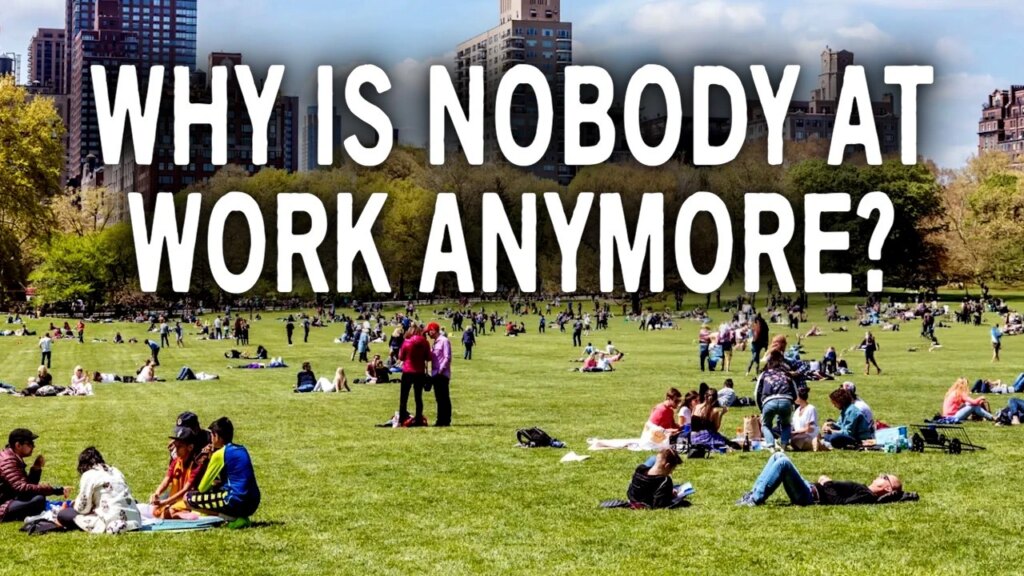
The American labor market is sending a strange message. Unemployment remains relatively low, layoffs are still limited by historical standards and millions of people continue showing up for work every day, yet a smaller share of the population is participating in the labor force than before the pandemic. At the same time, recent college graduates are struggling to find footholds, older workers have left the workforce in large numbers and employee engagement has weakened. The result is often described as a crisis of work ethic, but the data point to something more complicated.
The U.S. labor-force participation rate stood at 61.8% in September 2026, down from 62.5% a year earlier and below the 63% range that prevailed before the pandemic. Adult men had a participation rate of 68.7%, while the rate for adults age 25 and older was 62.7%. Those figures do not represent an all-time low, but they show that the share of Americans working or actively looking for work remains subdued even with unemployment at only 4.2%.
Older Americans Are a Big Part of the Participation Decline
One major reason participation has weakened is demographic rather than cultural. The large baby-boom generation is aging into retirement, which mechanically reduces the share of the population participating in the workforce. The Federal Reserve says the employment-to-population ratio for people age 55 and older is about 3.5 percentage points below its 2019 average, with most of that gap explained by the aging of the population itself.
The pandemic accelerated that process for some older workers. The Fed found that workers age 65 and older began retiring somewhat earlier than usual during the pandemic, adding additional downward pressure to employment among older Americans. Some people had enough home equity, retirement savings or investment gains to leave work earlier than expected, while others may have reassessed how long they wanted to remain employed after the disruption of COVID-19.
That means a lower participation rate does not automatically imply that millions of prime-age workers suddenly decided they no longer value employment. Part of the decline reflects a country with more retirees relative to working-age adults. Demographics can produce a weaker headline participation rate even when labor-market behavior among younger groups changes much less dramatically.
Young Workers Are Facing a Different Problem
For younger Americans, the issue increasingly appears to be difficulty getting into the labor market rather than simply choosing not to participate. The unemployment rate for people ages 20 to 24 reached 8.0% in September 2026, nearly double the overall unemployment rate. The participation rate for that age group was still a relatively high 71.5%, suggesting that many young adults are trying to work even as hiring has become more difficult.
Recent college graduates are experiencing the same problem. The Federal Reserve Bank of New York reported that unemployment among recent graduates was about 5.6% in the second quarter of 2026, while roughly 42% were underemployed, meaning they were working in jobs that typically do not require a college degree. That is a difficult environment for graduates who were told a degree would provide a relatively direct path into professional employment.
The gap is particularly significant because the beginning of a career can shape earnings for years. A graduate who cannot get an entry-level professional role may accept unrelated work, delay moving out, continue school or remain dependent on family longer than expected. Those decisions can look like delayed adulthood or unwillingness to work from the outside even when the underlying problem is that the first rung of the career ladder has become harder to reach.
Technology Is Changing the Entry-Level Ladder
Artificial intelligence is adding another layer of uncertainty. Jobs historically assigned to junior employees often involve research, basic coding, drafting, data analysis and routine administrative tasks, many of which are increasingly being automated or augmented by AI tools. That does not mean AI is eliminating the entire labor market, but it may reduce the number of traditional entry-level positions companies need.
The New York Fed has specifically examined whether remote work and generative AI are contributing to higher unemployment among young college graduates. It noted that unemployment among recent graduates had risen from 3.6% in March 2019 to 5.6% in March 2026, with remote work potentially reducing the value of hiring inexperienced workers who traditionally learned by working alongside more experienced colleagues.
Global policymakers are increasingly concerned about the same issue. At the IMF and World Bank meetings in October 2026, officials warned that AI-related disruption may become particularly visible in entry-level employment even if technology does not cause a broad collapse in total jobs. The risk is that companies continue employing experienced workers while using technology to perform some of the tasks that once justified hiring a new graduate.
The Labor Market Can Be Strong and Weak at the Same Time
The current labor market is difficult to describe with a single word because different indicators are telling different stories. Initial unemployment claims fell to about 197,000 in early October, remaining near historically low levels and suggesting that employers are not conducting mass layoffs. Yet job growth has slowed significantly, with only 29,000 jobs added in September.
That combination creates a labor market sometimes described as “low hire, low fire.” People who already have jobs are relatively secure, but people trying to enter the workforce or change careers may struggle to find openings. The median duration of unemployment has also increased, another sign that job seekers can remain out of work longer even without a surge in layoffs.
This distinction helps explain why workers and employers can describe the economy so differently. A business may see low turnover and assume labor conditions are stable, while a graduate sending dozens of applications without receiving interviews experiences the same market as deeply dysfunctional. Both observations can be true at the same time.
Employee Engagement Is Low, but Most Workers Haven’t Quit
The claim that almost nobody cares about work is overstated, but employee engagement is undeniably weak. Gallup’s 2026 workplace report found that 32% of U.S. employees were engaged at work based on 2025 data, while 51% were classified as not engaged and 17% as actively disengaged. That is a meaningful deterioration from 2020, when engagement reached a high of roughly 36%.
Younger workers have experienced some of the largest declines. Gallup found engagement among Generation Z and younger millennials fell eight percentage points between 2020 and 2025, while older millennials saw an even larger decline. Those numbers suggest that workplace dissatisfaction is not simply an internet narrative, even though disengagement is different from refusing to work.
A disengaged employee can still work full time, meet minimum expectations and remain employed for years. The problem for employers is that those workers may be less productive, less willing to take on additional responsibility and more likely to leave when an opportunity appears. The broader concern is therefore not that Americans have stopped working, but that many no longer feel particularly connected to the organizations employing them.
Poor Jobs Can Reduce the Incentive to Participate
Not every available job offers enough compensation, stability or advancement to attract workers. Some positions combine low wages with unpredictable schedules, weak benefits and limited opportunities for promotion, making them less attractive to people who have alternatives such as staying in school, living with family or holding out for a better role. From an employer’s perspective, that can look like a worker shortage even when the underlying problem is a mismatch between the job being offered and the compensation required to fill it.
Management quality matters as well. Employees who feel ignored, mistreated or trapped under poor managers can become disengaged even when their pay is competitive. Gallup’s research has repeatedly linked engagement with whether employees understand expectations, receive useful feedback and feel supported by their managers, suggesting that workplace culture can be as important as salary in determining whether someone wants to stay.
That does not mean every worker expectation is realistic. Some applicants do enter the labor market expecting high salaries before developing the experience or specialized skills that would justify them. The mismatch can therefore work in both directions, with employers sometimes offering too little and applicants sometimes expecting more than the market will support.
Younger Workers Also Have Different Expectations About Work
Generational differences can intensify this tension. Younger workers came of age watching parents endure layoffs, seeing student debt rise and experiencing the pandemic during school or the beginning of their careers. Many therefore place greater value on flexibility, work-life balance and the ability to change employers rather than assuming loyalty to one company will eventually be rewarded.
Older generations can interpret those preferences as weaker commitment. Younger workers may instead view them as rational responses to a labor market where pensions are rare, job security is limited and careers increasingly involve several employers. Neither perspective entirely captures the other because each generation entered the workforce under different economic conditions.
The conflict becomes sharper when expectations about pay diverge. A young worker may look at housing, health care and student-loan costs and conclude that a traditional entry-level salary no longer provides the lifestyle previous generations could achieve. An employer may look at the applicant’s limited experience and conclude that the requested salary is disconnected from the economic value of the job.
Education Can Delay Entry Into Full-Time Work
Americans are also spending more time in education than previous generations did. College, graduate school and professional training can delay full-time labor-force participation, particularly when young adults believe additional credentials are necessary to compete for professional jobs. The trade-off is that people can enter the workforce later while carrying more student debt and higher expectations about the jobs those credentials should provide.
That creates a difficult cycle when the professional labor market weakens. Someone who spends years earning a degree may be reluctant to accept a job that pays little more than work that did not require the credential. Waiting for a better opportunity can look like unwillingness to work, while accepting an underemployed position can make the investment in education feel disappointing.
The New York Fed’s 42% underemployment rate among recent graduates captures part of this mismatch. College still produces meaningful lifetime earnings advantages on average, but the path from graduation to a degree-level career is no longer guaranteed to be immediate or smooth.
Geography Can Trap Workers in Weak Labor Markets
Employment opportunity also varies enormously by location. West Virginia provides one of the clearest examples, with a labor-force participation rate of only 53.8% in August 2026, compared with 61.8% nationally in September. Neighboring Virginia had a participation rate of 62.8% in August, illustrating how dramatically labor-market participation can differ across state lines.
Those differences are shaped by demographics, health, education, industry mix and decades of economic change. Communities that lose manufacturing, mining or other major employers do not automatically replace those jobs with equally well-paying industries. Younger residents may leave in search of opportunity, leaving behind an older population and reducing the local labor-force participation rate further.
Moving is not always an easy solution. Relocating requires money for deposits, transportation, child care and potentially higher housing costs, while leaving behind family support can create additional expenses. People can therefore remain in regions with weak employment opportunities not because they are unwilling to work, but because moving to where the jobs are requires resources they do not have.
Male Labor-Force Participation Has Been Falling for Decades
The decline in male labor-force participation is particularly important because it began long before COVID-19. Adult men had a participation rate of 68.7% in September 2026, down from 69.5% one year earlier, but the larger story stretches back decades as participation among working-age men has gradually declined.
Economists have pointed to several possible causes, including the decline of manufacturing employment, disability, opioid addiction, incarceration, automation and reduced demand for workers without college credentials. No single explanation accounts for the entire trend, and the causes vary across regions and demographic groups. What is clear is that the phenomenon cannot reasonably be attributed to one generation suddenly developing a weaker work ethic.
The economic consequences can be significant. Lower participation reduces household income, tax revenue and potential economic output while increasing the number of people relying on family members or public programs. It can also weaken communities when large numbers of working-age residents become detached from employment for years at a time.
Money Still Matters, but So Does the Quality of the Job
Employees ultimately trade time and effort for compensation, so wages remain one of the strongest incentives to work. When pay rises enough, employers generally find it easier to attract applicants, particularly for jobs that are difficult, inconvenient or physically demanding. That basic labor-market relationship has not disappeared simply because attitudes toward work have changed.
But compensation is broader than an hourly wage. Health insurance, retirement benefits, predictable scheduling, paid leave, flexibility and opportunities for advancement all influence whether a job feels worthwhile. Two positions paying the same salary can produce very different employee experiences if one provides stability and respect while the other creates constant uncertainty.
Companies that describe every hiring difficulty as a shortage of willing workers can therefore miss part of the problem. Workers also make economic decisions, and they may reject a job when the compensation does not justify the commute, child-care costs or working conditions. Labor markets work through negotiation between employers and employees rather than through one side unilaterally deciding what work should be worth.
Workers Can Also Misjudge Their Market Value
The opposite problem deserves attention as well. A degree, certification or desire for a certain lifestyle does not guarantee that employers will pay enough to support it. Compensation ultimately depends partly on how scarce a worker’s skills are and how much economic value those skills create.
Someone entering a competitive field may therefore need to accept a lower starting salary than expected while developing experience. That can be frustrating when housing and other costs are high, but career earnings often depend on building skills that increase bargaining power over time. Rejecting every opportunity because it falls short of an ideal starting salary can delay that process.
The difficulty today is that some of those traditional starter roles are disappearing or becoming more competitive. Workers are being told to gain experience at the same time employers are reducing the number of jobs designed for inexperienced applicants. That contradiction is becoming one of the central challenges facing the next generation of workers.
The Real Problem Is a Growing Mismatch
America does not appear to be experiencing a simple collapse in people’s desire to work. The unemployment rate remains relatively low, tens of millions of adults remain highly attached to the labor force and jobless claims show that employers are still reluctant to dismiss workers. The harder problem is that the workers available, the jobs being created and the expectations on both sides are increasingly misaligned.
Older Americans are retiring while younger workers struggle to enter professional careers. Some employers cannot fill low-paying or difficult jobs, while some graduates cannot find positions that match their education. Technology is eliminating or restructuring certain entry-level tasks at the same time that employees report weaker engagement with the organizations they work for.
Those pressures can easily be turned into a generational argument about who works harder. The economic data suggest a more useful conclusion: the American employment system is changing faster than many of the institutions built around it. Education, management, geography, technology, compensation and demographics are all reshaping who works and what workers expect in return.
The future of work will therefore depend on more than convincing people to try harder. Employers will need to create jobs worth taking, workers will need skills that remain valuable as technology changes and communities will need ways to connect people with opportunity. If those pieces remain disconnected, lower participation and worker frustration are likely to remain symptoms of a much larger labor-market problem.