Jaguar’s Biggest Gamble in Decades Debuts in October
Jaguar’s Biggest Gamble reaches New York this October as the Type 01 electric GT begins a costly, low-volume reinvention.
After nearly two years of debate over its advertising, logos, colors and Type 00 concept, Jaguar will finally reveal the production Type 01 in New York this October. No Jaguar in recent memory has carried more corporate pressure.
This is not a routine model change. Jaguar has wound down its former lineup and wiped the slate clean. It is rebuilding around expensive, deliberately scarce battery-electric vehicles, making Type 01 the opening argument for a different business.
Much of the online battering has come from people who have not bought a Jaguar in decades, if ever. It is a little like standing outside a restaurant to review a meal you never ordered. You may dislike the new design, but dismissing the car without experiencing its engineering is a different matter.
You may also enjoy: Jaguar Type 00: Smooth, Linear, Powerful, Return to Soul
You may also enjoy this video:
Jaguar Type 01 Gets Its New York Moment
JLR Chief Commercial Officer Leonard Hoornik confirmed New York and October during a June investor presentation. Jaguar has not disclosed the date or venue, but JLR considers North America a priority growth region.
The Type 01 follows the two-door Type 00 design vision shown at Miami Art Week in 2024. Its long hood, low roof and emphatic surfaces survive on the four-door GT. Monaco and Goodwood prototypes indicate Jaguar has not retreated.
Jaguar confirmed the name in May: zero for electric propulsion and zero tailpipe emissions; one for the first Jaguar of a new generation. The dedicated-architecture GT will be built as an all-electric car in Britain.
You may also enjoy: Will Jaguar Make It? Reinventing an Icon
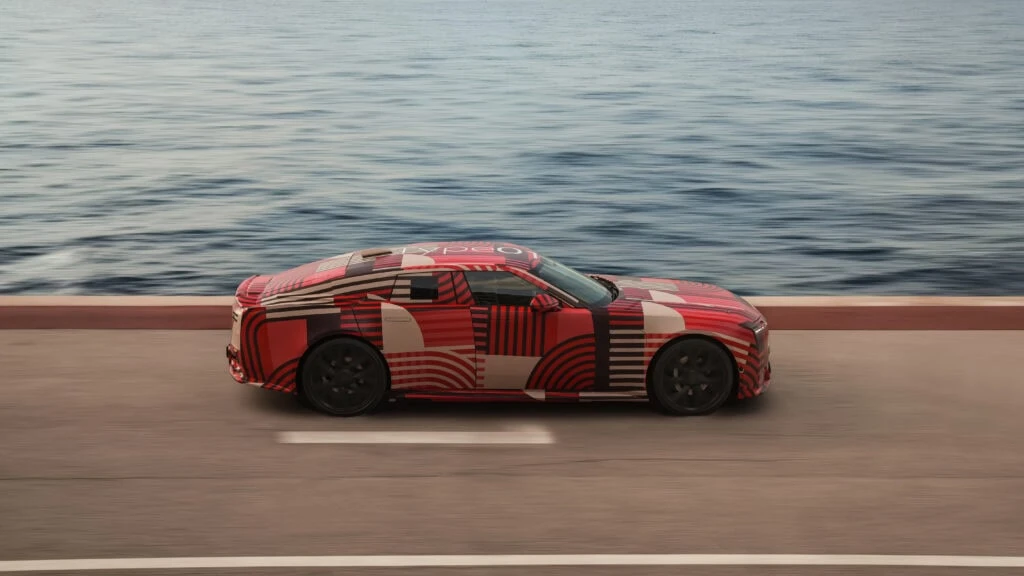
Side view of Jaguar’s type 00 along the coast of France, Spain, and Monaco
Why the Type 01 Matters More Than One Car
I have already driven a camouflaged Type 01 development car at Jaguar headquarters in Gaydon, England. Despite its online pounding, it was probably one of the best cars I have ever driven. I did not reach that conclusion from a design presentation.
On the test track, I thought I was traveling perhaps 80 or 90 mph. The engineer beside me placed a hand firmly on my shoulder: the limit was 150. I was doing 160. The remarkable part was how completely the car concealed the violence of that speed.
Power arrived smoothly and progressively. The chassis was calm, planted and communicative, with the long-legged character of a proper Jaguar GT. The road seemed to shrink beneath it, a reminder that battery performance is only one part of a great EV.
You do not have to love the styling. Jaguar knew its new shape would divide opinion. What is harder to deny from behind the wheel is the extraordinary engineering underneath it.
You may also enjoy: Jaguar Finalises Electric Four-Door GT After Bold Debut
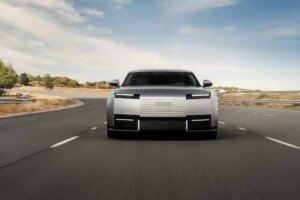
Front view of Jaguar’s type 00 along the coast of France, Spain, and Monaco
Why Jaguar’s Biggest Gamble Is the Price
JLR’s original guidance called for indicative pricing from £100,000. Reporting has placed the expected American starting point around $130,000, while $150,000 has become a broad positioning estimate. Until Jaguar publishes an MSRP, this is a six-figure electric GT, not a confirmed $150,000 car.
Jaguar has not confirmed whether annual volume will be 3,000 cars, 5,000 or something else. The strategy matters more: deliberate scarcity. Jaguar does not need the approval of everyone who has not bought one in 50 years.
Price alone cannot create ultraluxury credibility. Buyers will expect exceptional materials, personalization, service and reliable software. The ownership experience—including public charging—must be as convincing as the car felt at Gaydon.
You may also enjoy: Why the Rolls-Royce Luxury Experience Is the Real Product
Track view of Jaguar’s type 00 along the coast of France, Spain, and Monaco
What Jaguar Has Confirmed About the Type 01
Jaguar says the tri-motor all-wheel-drive system produces more than 1,000 horsepower and over 1,300 Nm, or 959 pound-feet, of torque. Torque vectoring, all-wheel steering, air suspension and active twin-valve dampers help explain its speed and composure.
Jaguar used 150 prototypes across desert roads, frozen lakes and virtual tests. Development at minus 40 degrees helped calibrate the powertrain, chassis and ThermAssist system. Jaguar says ThermAssist can cut heating-energy use by up to 40 percent.
Targets include up to 430 miles of EPA range and 200 miles added in about 15 minutes. Those are not certified production figures. Battery capacity, final range and the charging curve remain undisclosed.
You may also enjoy: Range Rover GT Could Compete With Jaguar
Top down view of Jaguar’s type 00 along the coast of France, Spain, and Monaco
Jaguar Remembered That Driving Comes First
This is not a halfhearted comeback. Jaguar stepped away from the old business and decided who it wanted to be: at its best, a car company that loves the drive.
The lineage began with the Swallow Sidecar Company in 1922. William Walmsley’s sidecar used a streamlined, bullet-shaped aluminum body, while William Lyons recognized that style and motion sold an experience. That instinct traveled into Jaguar road cars.
The E-type and 1960s and 1970s XJs made speed feel less like strain and more like gliding inside a bullet. Type 01 engineers returned to the XK120, E-type, XJS and several XJs to study their performance, comfort and power in reserve.
Type 00 introduced the visual philosophy; Type 01 must make it real. It is not a retro E-type or electric XJ, but it carries the same effortless momentum. The car feels engineered around driving, not merely an electric platform.
New York must still provide pricing, timing, the finished cabin and ownership details. Yet Jaguar has already answered whether it can create an unmistakable driving character. If production preserves what I experienced at Gaydon, buyers are going to get something unbelievable.