Retirement Can Create a Tax Window Most People Never Use
Retirement is often described as the point when income falls and taxes become simpler. For many households, the opposite is true. Wages may disappear, but withdrawals from traditional IRAs, Social Security benefits, investment gains, pensions and eventually required minimum distributions begin interacting in ways that can make a retiree’s marginal tax rate much higher than the headline tax bracket suggests.
That complexity also creates opportunity. The years immediately after work ends can be some of the most valuable tax-planning years of a person’s life, particularly when salary has stopped but Social Security and RMDs have not yet fully arrived. During that period, retirees may be able to realize long-term capital gains at a 0% federal rate, convert traditional IRA money to Roth at relatively low ordinary-income rates and reduce the size of future mandatory distributions.
The key is coordination. Tax-gain harvesting, Roth conversions and Social Security claiming cannot be optimized independently because each dollar of income affects the room available for the others. The best strategy is usually not minimizing this year’s tax bill but using low-tax years deliberately so that future years become easier.
The 0% Capital-Gains Bracket Can Be Extremely Valuable
Long-term capital gains receive preferential federal tax treatment compared with ordinary income. For 2026, the 0% long-term capital-gains rate applies up to $49,450 of taxable income for most single filers and $98,900 for married couples filing jointly. Above those thresholds, most long-term gains move into the 15% bracket before potentially reaching 20% at much higher income levels.
That creates a planning opportunity for retirees whose ordinary income falls substantially after leaving work. Suppose a married couple has taxable income well below $98,900 before selling appreciated investments. They may be able to realize enough long-term capital gains to fill some or all of the remaining 0% capital-gains bracket without paying federal tax on those gains.
The transaction is sometimes called tax-gain harvesting. Instead of waiting for a future year when the same gain might be taxed at 15% or more, the investor deliberately sells appreciated assets while the tax rate is unusually favorable. The proceeds can be spent, reinvested in another asset or, subject to normal investment considerations, reinvested in the same security because wash-sale rules apply to losses rather than gains.
The strategy can also increase the cost basis of the investment. If a retiree sells stock purchased for $30,000 when it is worth $60,000 and realizes the $30,000 gain at a 0% federal rate, repurchasing the investment at roughly $60,000 establishes a much higher basis for future tax calculations. The household has effectively recognized a gain while paying little or no federal capital-gains tax.
The 0% Rate Is Not Based on Capital Gains Alone
One of the most important details is that the 0% threshold depends on taxable income, not just the amount of capital gains being realized. Ordinary income fills the lower portion of the tax return first, and long-term gains sit on top of it.
A retired couple receiving pension income, interest, taxable IRA withdrawals or part-time wages therefore has less room for 0% capital gains than another couple with the same portfolio but very little ordinary income. Realizing a $90,000 gain does not automatically mean all $90,000 qualifies for the 0% rate simply because the married threshold is $98,900.
The standard deduction helps create additional space. For 2026, married couples filing jointly receive a $32,200 standard deduction, while single filers generally receive $16,100 before considering additional age-based deductions and other adjustments. The relationship among gross income, deductions and taxable income is therefore what determines how much capital gain can fit below the 0% threshold.
State taxes also matter. A gain taxed at 0% federally can still be taxable by a state, depending on where the retiree lives. Tax-gain harvesting should therefore be evaluated using the entire tax picture rather than the federal rate alone.
Social Security Can Create a Hidden Marginal Tax Rate
Social Security introduces one of the strangest features of retirement taxation because additional income can cause more of the benefit itself to become taxable. The IRS uses a calculation that considers one-half of Social Security benefits plus most other income and certain tax-exempt interest. If that combined amount exceeds specific thresholds, an increasing portion of Social Security becomes included in taxable income.
For married couples filing jointly, the first base amount is $32,000, while the higher threshold is $44,000. For single filers, the corresponding amounts are $25,000 and $34,000. Once income rises sufficiently, as much as 85% of Social Security benefits can be included in taxable income.
The phrase “85% of Social Security is taxable” is often misunderstood. It does not mean retirees face an 85% tax rate on their benefits. It means that as much as 85 cents of each benefit dollar can become part of taxable income, which is then taxed at the household’s applicable ordinary-income rates.
The difficulty is what happens while the household moves through the phase-in range. An additional dollar of IRA withdrawal can make that dollar taxable while simultaneously causing part of Social Security to become taxable. The effective marginal tax rate on the additional income can therefore be meaningfully higher than the nominal 10%, 12% or 22% bracket shown on the tax table.
The Social Security “Tax Torpedo” Can Make Small Withdrawals Expensive
This interaction is commonly called the Social Security tax torpedo. It occurs because retirees can experience a period in which extra income pulls additional Social Security benefits onto the tax return at the same time.
Suppose a retiree sits in the 12% ordinary-income bracket. An additional $1,000 of IRA income might not simply create $120 of federal tax if it also causes several hundred dollars of Social Security to become taxable. The effective tax on that incremental withdrawal can therefore be considerably higher than 12%.
That does not mean retirees should avoid all income that makes Social Security taxable. Sometimes recognizing additional income is still the correct long-term decision, particularly if it prevents much larger RMDs later. The mistake is assuming the printed tax bracket tells the entire story.
Tax-planning software can be especially useful here because the interaction is difficult to evaluate mentally. The household should examine the marginal tax cost of the next $1,000 or $10,000 of income rather than relying solely on the average effective tax rate shown on last year’s return.
Roth Conversions Can Be Most Valuable Before Social Security Starts
The cleanest way to avoid the Social Security tax torpedo is often to recognize some traditional IRA income before Social Security begins. A retiree leaving work at 62 and delaying benefits until 67 or 70 may have several years when salary is gone, Social Security is absent and RMDs have not begun.
Those years can create significant room in the 10% and 12% federal tax brackets. For 2026, married couples filing jointly remain in the 10% bracket through $24,800 of taxable income and the 12% bracket through $100,800. Single filers remain in the 12% bracket through $50,400.
A retiree could deliberately convert traditional IRA money to Roth during those lower-income years, paying tax at 10% or 12% on dollars that might otherwise be distributed later at a substantially higher marginal rate. The converted money then moves into an account whose qualified withdrawals can generally be tax-free and whose original owner is not subject to lifetime Roth IRA RMDs.
The conversion should still be evaluated against future rates rather than performed automatically. If a retiree is likely to remain in a low bracket throughout retirement, paying tax early may offer little benefit. The strategy becomes most attractive when today’s low rate is likely to be temporary.
The Best Roth Conversion Is Often Smaller Than People Expect
Roth conversions have become popular enough that retirees can overuse them. Someone who learns that future RMDs may be expensive can become determined to convert the entire traditional IRA before mandatory distributions begin.
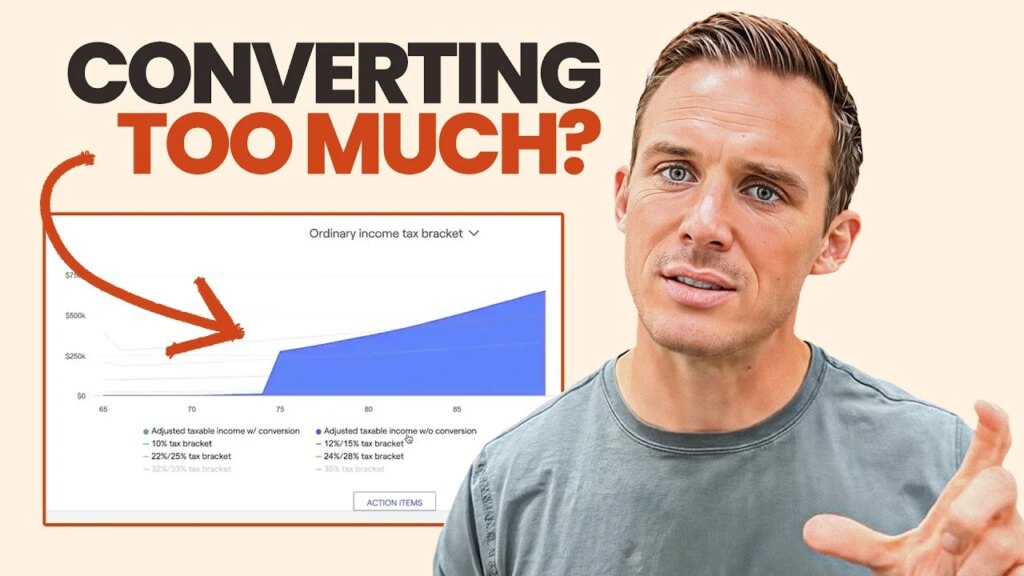
That can create a new tax problem. Converting beyond the 12% bracket into 22%, 24% or higher rates may make sense for some affluent households, but it should not be done simply because Roth assets are attractive. Every additional conversion dollar has a marginal tax cost today.
For many retirees, the better strategy is incremental. Convert enough to fill a targeted bracket without unnecessarily spilling into a rate that is unlikely to be avoided later. A $40,000 conversion at 12% can be extremely attractive if that money would otherwise emerge at 22% or 24%, while converting an additional $100,000 at a high current rate may offer little incremental benefit.
The correct amount changes annually. Investment gains, pension income, charitable deductions, healthcare expenses and changes in tax law can all alter the opportunity from one year to the next.
Tax-Gain Harvesting and Roth Conversions Compete for the Same Space
One of the most important planning decisions is whether to use a low-income year for Roth conversions or capital-gain harvesting. Both strategies can be valuable, but they often compete for limited room on the same tax return.
Suppose a married retired couple has $50,000 of taxable ordinary income before taking any action. With the 0% long-term capital-gains threshold at $98,900 in 2026, they may have roughly $48,900 of room before long-term gains begin spilling into the 15% bracket, ignoring other complications.
If they first complete a $40,000 Roth conversion, taxable income rises and much of that 0% gain-harvesting opportunity disappears. Conversely, harvesting a large gain may make an additional Roth conversion more expensive. The optimal answer depends on which future tax liability is more important to reduce.
A household with a giant traditional IRA and modest taxable gains may prioritize conversions. Another with a small IRA but highly appreciated brokerage assets may benefit more from harvesting gains. The mistake is trying to maximize both independently as though the tax brackets do not interact.
Large IRA Balances Can Become Expensive Later
Required minimum distributions eventually reduce the retiree’s ability to control taxable income. Under current law, the applicable RMD age is 73 for people who reach 73 before 2033 and 75 for those subject to the later SECURE 2.0 schedule.
A traditional IRA that continues growing for decades can therefore create substantial mandatory income later. If Social Security, pensions and investment income already fill the lower brackets, RMDs can push additional dollars into higher rates even if the retiree has no need to spend the distribution.
Reducing the traditional IRA through measured Roth conversions before RMD age can lower future mandatory distributions. The strategy can also make the tax return more predictable because Roth withdrawals provide a source of cash that generally does not increase taxable income when qualified.
Again, the objective should not be eliminating every future RMD. Large mandatory distributions usually indicate that the portfolio performed well. The real objective is preventing unnecessary concentration of retirement wealth in one tax category.
The Widow or Widower Penalty Makes Future Taxes Harder to Ignore
Married retirees also need to consider what happens after the first spouse dies. Household income often declines, but tax brackets become much narrower because the survivor generally files as single rather than married filing jointly.
A couple that comfortably occupies a moderate married tax bracket can therefore leave the surviving spouse facing a higher marginal rate on a similar amount of taxable income. Social Security income may fall because one benefit disappears, but RMDs and pension income may decline much less.
This creates another argument for recognizing some income while both spouses are alive and filing jointly. Roth conversions completed during the married years can reduce the pretax balance the surviving spouse eventually inherits and provide tax-free flexibility after filing status changes.
The correct strategy depends heavily on expected longevity and survivor income. Tax planning should model both spouses alive and one-spouse-surviving scenarios rather than assuming the joint return lasts forever.
Capital Gains Can Also Affect Medicare
The federal capital-gains rate is not the only consideration when harvesting appreciated assets. Realized gains increase modified adjusted gross income, which can affect Medicare’s income-related monthly adjustment amount, or IRMAA, for higher-income beneficiaries.
Medicare generally looks back two years when determining IRMAA. A large gain harvested at age 64 or 65 can therefore create higher Part B and Part D costs later even if the federal capital-gains tax itself is 0% or 15%.
That does not automatically make harvesting the gain a mistake. Paying a temporary Medicare surcharge can still be worthwhile if the transaction permanently removes a substantial future capital-gains liability. The Medicare cost simply needs to be included when measuring the strategy.
This is another example of why minimizing the tax displayed on Form 1040 is not the same as minimizing total retirement costs. Income decisions can affect healthcare premiums as well as income taxes.
The 0% Capital-Gains Rate Can Reset Basis Without Changing the Portfolio
One of the most attractive features of tax-gain harvesting is that retirees can sometimes recognize a gain while preserving essentially the same investment exposure. Because wash-sale rules generally apply to losses, an investor can sell an appreciated security, realize the gain and repurchase it if maintaining the position remains appropriate.
Suppose $100,000 of stock has a $50,000 cost basis. If a retiree can recognize the $50,000 gain inside the 0% federal bracket and repurchase the stock at roughly $100,000, the new cost basis is approximately $100,000. A future sale therefore begins with far less embedded gain.
That can be especially helpful when a retiree expects future income to rise. Harvesting gains while Social Security and RMDs are low can effectively move taxable income from a future 15% capital-gains environment into today’s 0% environment.
The approach still requires investment discipline. Tax savings should not justify holding an inappropriate asset or creating unnecessary transaction costs. Tax strategy works best when it supports the investment plan rather than dictating it.
Low-Income Retirement Years Are a Limited Resource
The period between retirement and the arrival of Social Security and RMDs can be surprisingly short. Someone retiring at 65 and claiming Social Security at 67 may have only two especially clean tax years before another major source of income begins.
Waiting until RMD age to start planning can therefore mean missing the best opportunity entirely. By then, the government has begun determining how much traditional retirement money has to come out each year.
The planning process should ideally begin before retirement. Estimate spending, identify which accounts will fund that spending, project Social Security and pensions, estimate future RMDs and then look for tax brackets that would otherwise go unused.
That makes retirement tax planning fundamentally different from tax preparation. Tax preparation reports what already happened. Planning decides what income should happen before December 31.
There Is No Single “Perfect” Roth Conversion Bracket
It is tempting to say retirees should always fill the 12% bracket with Roth conversions. For many households, that can be attractive, but it is not a universal rule.
A wealthy retiree with several million dollars in a traditional IRA may reasonably convert into the 22% or 24% bracket if future RMDs are likely to push income there anyway. Another retiree with modest pretax savings may gain little from paying 12% today if future withdrawals are also expected to remain at 12%.
The decision becomes even more complicated when Social Security taxation is involved. A conversion at an apparent 12% marginal rate may effectively cost more if it makes additional benefits taxable, while a conversion completed before Social Security starts can avoid that interaction entirely.
The correct question is not, “What bracket am I in?” It is, “What tax rate will this dollar face if I pay it today, and what tax rate is it likely to face if I wait?”
Retirement Tax Planning Is About Filling Brackets Intentionally
Most workers spend their careers trying to reduce taxable income. They maximize retirement contributions, claim deductions and postpone taxes whenever possible. Retirement can require the opposite mindset.
A low-income year may be valuable precisely because the household has unused tax capacity. Leaving the entire 10% or 12% bracket empty is not automatically a victory if it means traditional retirement money later emerges at 22% or 24%. Similarly, refusing to recognize a capital gain because it creates taxable income can be shortsighted if the gain could have been realized at a 0% federal rate.
Good planning uses those brackets intentionally. Some years may be ideal for capital-gain harvesting, others for Roth conversions and still others for doing very little because income is already elevated.
The objective is lifetime efficiency. Paying $5,000 more in federal taxes this year can be a good decision if it avoids $20,000 later.
The Lowest Tax Bill This Year Is Not Always the Best Outcome
Retirees often judge tax planning by one number: how much they owe in April. That is understandable, but it can encourage decisions that reduce current taxes while creating larger future liabilities.
A traditional IRA withdrawal that is avoided today may become an RMD later. A capital gain left unrealized at a 0% rate may eventually be taxed at 15%. A Social Security claim made earlier than necessary can eliminate years in which Roth conversions could have been completed with less interaction from other income.
The best retirement tax plan therefore looks across decades rather than individual tax returns. It coordinates taxable investments, Roth conversions, Social Security, pensions and RMDs so that income is distributed across brackets rather than concentrated into the least favorable years.
For many retirees, the most valuable tax opportunity does not come from finding another deduction. It comes from recognizing that retirement creates a brief period when taxable income is unusually controllable. Using that window deliberately can make every later stage of retirement easier.
The irony is that some of the best tax planning requires paying taxes before the IRS forces you to. Harvesting gains at 0% and converting traditional IRA dollars at low ordinary-income rates can feel counterintuitive because both strategies intentionally create taxable income. When that income replaces a more expensive future tax bill, however, voluntarily paying tax can be one of the most effective ways to reduce taxes over the rest of retirement.
You should always consult a financial, tax, or legal professional familiar about your unique circumstances before making any financial decisions. This material is intended for educational purposes only. Nothing in this material constitutes a solicitation for the sale or purchase of any securities. Any mentioned rates of return are historical or hypothetical in nature and are not a guarantee of future returns.
Past performance does not guarantee future performance. Future returns may be lower or higher. Investments involve risk. Investment values will fluctuate with market conditions, and security positions, when sold, may be worth less or more than their original cost.