Why Factory Jobs are NOT the Solution
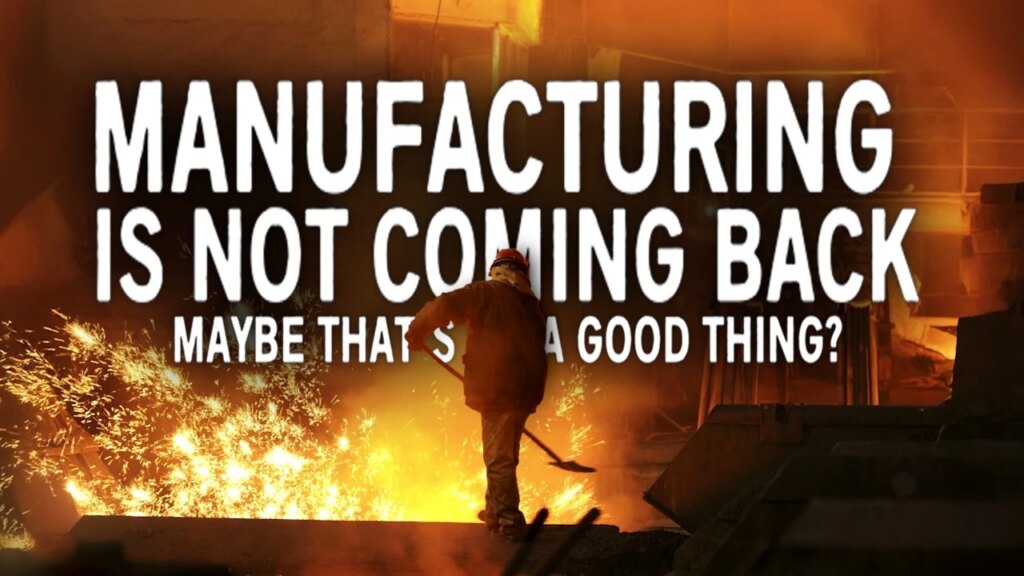
For decades, manufacturing jobs were treated as work the United States was supposed to move beyond. Factories were dangerous, physically demanding, and increasingly easy to outsource or automate, while college degrees and office jobs were presented as the path toward a more prosperous future. Now that narrative is reversing.
Factory jobs are once again being promoted as a solution to stagnant wages, struggling communities, and an increasingly difficult white-collar job market. Governments are spending billions of dollars trying to attract new factories, while politicians across the political spectrum promise to restore domestic manufacturing. But the episode argues that bringing back factories may not recreate the middle-class prosperity people remember.
America Turned the World Into Its Factory Floor
The economic logic behind offshoring once seemed straightforward. Companies could move lower-skilled manufacturing work to countries where labor was cheaper while American workers moved into management, professional services, technology, and other higher-paying occupations.
In effect, the rest of the world became the factory floor while wealthy economies tried to occupy the office upstairs. The problem was that there were never enough high-paying positions at the top for everyone. The service economy expanded, but so did the number of workers competing for white-collar jobs.
New corporate positions appeared as technology, regulations, and business practices became more complicated. But simply creating more office jobs did not guarantee that each position would generate enough value to deliver steadily rising wages. Today, even many college graduates struggle to find jobs that comfortably support a household.
Globalization Eventually Reached White-Collar Workers Too
Manufacturing workers were initially the employees competing directly with lower-cost labor overseas. Over time, however, the countries doing outsourced production developed their own technical expertise, companies, engineers, managers, and professional services.
China is a clear example in the episode. American companies spent decades using Chinese factories because they were inexpensive, but Chinese businesses eventually developed the expertise to compete directly with many of the companies that originally hired them.
That means international competition is no longer limited to factory floors. Technology, engineering, finance, administration, and other professional work can increasingly be performed across borders as well. The global competition that disrupted manufacturing employment is now reaching much further into the service economy.
What Made Factory Jobs Good Wasn’t Just the Factory
The nostalgia surrounding manufacturing can also obscure what actually made many of those jobs attractive. One major factor was unionization. Organized workers in industries such as automobiles, shipping, and logistics have historically had greater bargaining power to negotiate wages and benefits.
As more workers moved into offices, union membership became much less common. Many white-collar employees began viewing themselves as part of management even though they were still exchanging their time and expertise for a paycheck. The result was that some traditionally blue-collar workers retained bargaining structures that many office workers did not.
Location mattered too. Factories generally require large amounts of inexpensive land, so manufacturing facilities often existed in communities where housing costs were relatively manageable. A factory salary in a lower-cost city could therefore provide a higher standard of living than a seemingly larger office salary in an expensive metropolitan area.
The job itself may not have been the magic ingredient. Affordable housing, worker bargaining power, benefits, and wages that supported a middle-class lifestyle were equally important.
Governments Are Spending Billions to Bring Manufacturing Back
Countries around the world are now trying to reverse decades of offshoring. Tariffs, subsidies, tax incentives, semiconductor programs, infrastructure spending, and industrial policy are all being used to encourage companies to build domestically.
The transcript draws heavily on economist Robert Lawrence’s argument that this strategy may be focusing on the wrong problem. Subsidizing manufacturing can create factories, but it does not guarantee the broad-based employment or middle-class prosperity associated with factories several generations ago.
Modern factories also require fewer workers because they are increasingly automated. Governments can spend enormous amounts attracting a semiconductor plant or advanced manufacturing facility only to discover that the operation employs far fewer people than an older industrial facility would have.
There is another contradiction. After decades of telling workers to attend college and pursue professional careers, manufacturers are now finding shortages of people with the specific technical skills needed for advanced production. Some projects have even turned to skilled foreign workers to fill positions, undermining the idea that factory subsidies will automatically provide jobs for displaced domestic workers.
Automation Makes the Manufacturing Revival Even Harder
Manufacturing is not returning in the form many people remember. The most competitive factories are increasingly automated, with robotics and software performing work that once required large numbers of employees.
That creates a fundamental tension. Governments may want factories because they want jobs, while companies want automation because they need to reduce costs and remain globally competitive. Asking a company to build domestically while also preventing it from automating could make its products too expensive to compete internationally.
The result could be substantial public investment supporting highly productive factories that simply do not employ enough people to rebuild the employment base policymakers hope to recreate.
The Bigger Problem Is the Quality of Work
The episode’s larger argument is that policymakers may be confusing a symptom with the underlying problem. Workers do not necessarily want factory jobs because manufacturing is inherently superior. They want jobs that provide enough income, stability, bargaining power, and benefits to support a comfortable life.
If that is the actual goal, manufacturing is only one possible route. Improving housing affordability, strengthening worker bargaining power, increasing workplace protections, and creating conditions where wages rise with productivity could potentially improve the quality of both blue- and white-collar jobs.
That distinction matters because economic nostalgia can lead governments to spend enormous amounts trying to recreate industries as they existed decades ago. The world has already changed through automation, globalization, technology, and education.
Bringing manufacturing back may still have strategic advantages, particularly in industries that are important for national security or supply-chain resilience. But rebuilding factories alone will not automatically rebuild the middle class. The more important challenge is recreating the economic conditions that once allowed an ordinary job—factory or otherwise—to provide an ordinary family with a secure life.